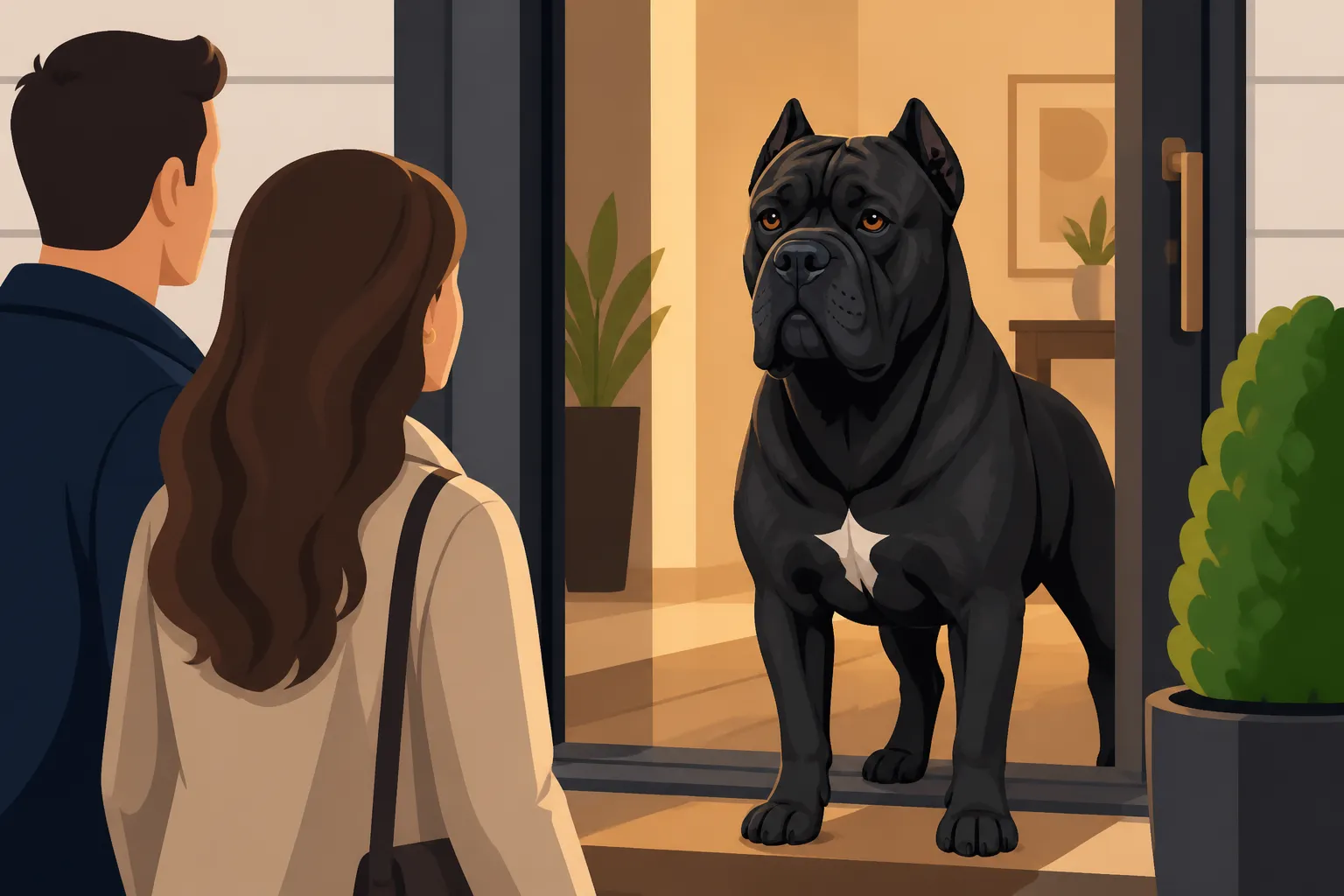
A Cane Corso Meeting Guests at the Front Door
Few things can be as nerve-wracking as the sound of your doorbell when you own a Cane Corso. That magnificent, powerful guardian who is your best friend might suddenly transform into a barking, lunging, intimidating presence, making both you and your guests incredibly uncomfortable. This guide will walk you through understanding your Cane Corso's natural instincts and provide practical, step-by-step strategies to ensure calm, safe, and respectful interactions when visitors come to your home.
The Cane Corso's Natural Response to New Faces at the Door
Before we even think about training, it's essential to understand the core drives that make your Cane Corso react the way they do when someone approaches your home. These aren't necessarily bad traits; they're inherent to the breed, but they need proper guidance.
Understanding the Guardian Instinct
Your Cane Corso was literally bred for centuries to protect. Their ancestors were Roman war dogs, then later livestock and property guardians in rural Italy. When someone comes to your door, whether a delivery driver, a friend, or even family, your dog often perceives it as an intrusion into their territory and a potential threat to their "flock"—which is you and your family. This isn't aggression for the sake of it; it's deep-seated protective wiring. They're telling you, "Hey, I see this person, and I'm letting you know they're here. Are they safe?" This instinct is one of the reasons we love them, but it needs to be channeled appropriately. What a Cane Corso's Guardian Instinct Actually Is delves deeper into this fascinating aspect of their heritage.
What often appears as over-excitement, a flurry of barks, or a strong pull on the leash can stem from this inherent guardian role. They aren't just saying "hello"; they are assessing, asserting, and often, trying to control the situation. Their sheer size and presence amplify this natural response, making even a well-intentioned warning bark sound like a full-blown threat. It's crucial for us, as their owners, to step in and show them that we are in control and that their guarding duties are appreciated, but not needed in such an overt manner during routine visits.
The Power of the Unknown and Cane Corso Reactivity
For a Cane Corso, the unknown can be a powerful trigger. A strange person on their property, a new scent, an unfamiliar voice – these all register as potential anomalies. If your Cane Corso hasn't been properly socialized to understand that not every new person is a threat, or if they haven't learned impulse control, their reaction can be intense. This isn't always aggression; sometimes it's fear, sometimes it's overstimulation, and sometimes it's simply a lack of appropriate social skills around strangers on their turf. This is why Neutral Socialization for a Cane Corso at Twelve Weeks is so vital in puppyhood.
Think of it from their perspective: a loud knock, a sudden ring, and then a strange human appearing. Without training, it's a sensory overload that kicks their protective drive into high gear. They don't know if this person is coming to play, hurt, or just deliver a package. Their default is often to escalate to prevent potential threats. For dogs that are naturally more anxious, this can manifest as fear-based reactivity, where they try to "scare away" the perceived threat before it gets too close. Understanding What an Anxious Cane Corso Looks Like can help you differentiate between true guarding and anxiety.
Managing Excitement Versus Alarm
It's really important to distinguish between your Cane Corso being genuinely alarmed or aggressive and simply being over-the-top excited. A dog that is truly alarmed might show stiff body language, whale eye, growl deeply, or even attempt to bite. An excited dog might jump, whine, bark frenetically, or dash back and forth. While both behaviors are unwelcome when guests arrive, the underlying motivation impacts your training approach. Often, what looks like aggression at the door is actually a frustrated greeting or an over-stimulated dog without an outlet for its energy.
A Cane Corso's excitement is amplified by its size and strength. A happy bounce from a small dog is cute; from a hundred-pound Cane Corso, it's a potential injury. Their sheer enthusiasm can be overwhelming for visitors, leading to accidental knocks or scratches. We want to teach them to dial down that initial burst of energy and move into a more controlled, polite greeting. This means teaching them what to do instead of just telling them what not to do. If you notice your dog is constantly keyed up around the door, consider how much structured exercise and mental stimulation they're getting daily, as this often plays a huge role in overall impulse control. Ninety Minutes a Day and a Cane Corso's Mind discusses the importance of mental and physical engagement for this breed.
Building a Foundation: Essential Training Before Guests Arrive
Effective management of guest arrivals starts long before anyone rings the doorbell. It requires foundational training that gives your Cane Corso clear expectations and a safe, reliable alternative to door dashing and chaotic greetings.
Mastering the "Place" Command
The "place" command is arguably one of the most powerful tools in your arsenal for managing a Cane Corso at the front door. This command teaches your dog to go to a designated spot – a bed, a mat, a raised cot – and stay there until released, regardless of distractions. It provides a clear, acceptable behavior for your dog when guests arrive, redirecting their focus from the door to their "job." Start training this in a low-distraction environment and gradually increase the difficulty, practicing with the doorbell ringing (no one actually there yet) and people moving around the house. The Place Command That Saves a Cane Corso Household offers a deep dive into this essential skill.
To teach "place," lure your dog onto their designated spot with a high-value treat. As soon as they have four paws on it, mark the behavior (with a clicker or a verbal "yes!") and reward them generously. Repeat this several times. Then, start adding the verbal cue "place" as they move onto the mat. Once they understand going to the mat, begin adding duration by taking a step back, then returning and rewarding them for staying. Slowly increase distance and duration. Many trainers, like those at BAXTER & Bella, emphasize the "place" command as a cornerstone for household manners, and they have excellent step-by-step guides for teaching it. Eventually, your goal is for your Cane Corso to be able to go to their place and stay there even when the doorbell rings, and you answer the door.
Desensitization to Doorbell and Knocking
Your Cane Corso's reaction to the doorbell or a knock is often a conditioned response. They've learned that these sounds predict an exciting, often chaotic, event. The key to changing this is to desensitize them to the sounds and create a new association. Start by recording your doorbell or having someone gently knock. Play or make the sound at a very low volume, just enough for your dog to notice but not react intensely. As soon as they hear it and don't react, reward them. Repeat this many times. Slowly increase the volume over several sessions.
Once they are calm with the sound, incorporate the "place" command. Have them go to their place before you make the sound. Ring the doorbell, and if they stay calm on their place, reward them heavily. The goal is for them to associate the sound not with a frantic dash to the door, but with calmly remaining in their designated spot, knowing a reward is coming. This process takes time and consistency. You're essentially teaching them that the doorbell is a cue for a different behavior, rather than a trigger for chaos. Teaching a Cane Corso to Ignore the Doorbell provides more detailed instructions.
Early Muzzle Training for Peace of Mind
This might sound extreme to some, but I am a huge proponent of early muzzle training for all large, powerful breeds like the Cane Corso, especially when it comes to managing high-stress situations like guest arrivals. A well-fitted basket muzzle, introduced positively, is a safety tool, not a punishment. It can provide immense peace of mind for you, your guests, and even your dog, allowing for more relaxed interactions without the worry of accidental nips, jumping injuries, or perceived threats. It’s also incredibly useful for vet visits or emergencies.
Introduce the muzzle slowly and positively. Don't just strap it on. Start by letting your dog sniff it, then put a treat inside so they have to put their nose in to get it. Gradually increase the time they wear it, always associating it with positive things like treats, praise, or a special chew. You want them to view the muzzle as a benign, even pleasant, part of their routine. Products found on Amazon can offer a good range of comfortable, well-ventilated basket muzzles suitable for a Cane Corso's unique head shape. Why Every Cane Corso Should Be Muzzle Trained Early offers comprehensive steps for successful muzzle training.
Strategic Management: Handling the Moment of Arrival
Even with excellent foundation training, the actual moment guests arrive can be intense. Having a clear strategy in place is critical to prevent chaos and ensure everyone's safety and comfort.
Utilizing Crates and Designated Safe Zones
For some Cane Corsos, especially those still learning or those prone to higher excitement or anxiety, crating them or securing them in a designated safe zone (like another room with a baby gate) before guests arrive is the best option. This isn't a sign of failure; it's responsible ownership. It removes the dog from the immediate chaos of the entryway, allowing them to settle down and observe from a distance, or simply relax without the pressure of performing. Once guests are settled, you can then assess whether your Cane Corso is ready for a controlled introduction.
Ensure the crate is a positive space for your dog – comfortable, with a favorite chew toy (like a KONG stuffed with peanut butter) or a special treat. Never use the crate as punishment. If your Cane Corso is accustomed to their crate as a den, sending them there when guests arrive can actually reduce their stress by giving them a predictable, safe place during a potentially overwhelming event. This also means you need a crate that can actually hold a grown Cane Corso, which is no small feat! Crate Training a Cane Corso That Outgrows Every Crate discusses the challenges and solutions for this.
Leash Control and Controlled Greetings
If your Cane Corso is reliable enough to be out when guests arrive, leash control is paramount. Have your dog on a leash before the doorbell rings. This gives you immediate physical control and allows you to guide them to their "place" or simply hold them securely next to you. Use a sturdy leash and collar or harness. When guests enter, instruct them to ignore your dog completely until your dog is calm. No eye contact, no talking, no petting. This prevents your dog from being rewarded for jumping, barking, or lunging.
Once your Cane Corso is calm (sitting, lying down, or on their place), then you can allow a brief, controlled greeting. Keep greetings short and sweet, and always with you in control of the leash. If your dog gets too excited, the greeting ends immediately. You can step on the leash to prevent jumping, or simply lead them away to their place again. Teach your guests this protocol beforehand. It sounds strict, but it sets your dog up for success and teaches them that polite behavior leads to positive interactions. Leash Manners Before a Cane Corso Hits Ninety Pounds is an excellent resource for building this foundational control.
The "Meet Outside" Strategy
Sometimes, the threshold of your home is simply too high a trigger for your Cane Corso. In these cases, it can be incredibly effective to meet guests outside of your home, on neutral territory. Take your Cane Corso for a walk, and arrange to meet your guests a block or two away. Allow your dog to greet them casually on the walk, where the environment is less charged with territoriality. Once your dog has calmly acknowledged your guests, then walk back to the house together.
This strategy can significantly reduce the initial excitement and territorial guarding that occurs when someone "invades" your home space. By the time you all enter the house, your Cane Corso has already met and accepted the guests outside, making the transition indoors much smoother. This is especially helpful for Cane Corsos who have struggled with reactivity at the door or those who have missed out on adequate Socializing a Cane Corso Puppy Before Its Shots Finish experiences.
Maintaining Calm: During and After the Visit
The initial greeting is just one part of the puzzle. Keeping your Cane Corso calm and well-behaved throughout the visit is equally important.
Supervised Interaction Protocols
Once guests are inside and settled, and your Cane Corso has either been released from their crate or finished their controlled greeting, continue to supervise all interactions. Do not leave your Cane Corso unsupervised with guests, especially if those guests are unfamiliar with large dogs or if they are children. Even the most well-behaved Cane Corso is a powerful animal, and accidents can happen. Keep an eye on your dog's body language. Are they relaxed, or are they getting stiff, staring, or showing signs of discomfort?
Remind guests of the rules: no feeding table scraps, no rough play, and direct them on how to interact politely with your dog (e.g., offer a gentle scratch behind the ears rather than a frontal hug). If your dog starts to get too excited, restless, or pushy, redirect them back to their "place" or offer a mental activity like a puzzle toy. This constant management reinforces that you are in charge of the interactions and helps your Cane Corso understand their role during a visit.
Providing Structure Throughout the Visit
A Cane Corso thrives on structure and predictability. Don't let a guest visit be a free-for-all where all rules go out the window. Continue to enforce boundaries and expectations. If your dog isn't allowed on the furniture normally, that rule still applies. If they have a designated resting spot, encourage them to use it. This consistency is crucial for your Cane Corso to understand that even with exciting new people around, the fundamental household rules remain.
You might even incorporate short, structured training sessions during the visit. Ask your dog for a "sit," "down," or "place," and have your guests reward them (with your approved treats) for good behavior. This helps your Cane Corso associate guests with positive experiences and reinforces their training. A short sniffing walk or play session in the yard (if appropriate and safe for your dog and guests) can also help burn off some energy and provide a positive outlet. Remember, a tired dog is often a well-behaved dog. The Structure a Cane Corso Needs Every Single Day applies even, or especially, during special events.
Managing Post-Departure Excitement
When guests leave, some Cane Corsos experience another surge of excitement or relief. They might bark, whine, or run around the house. Just like with arrivals, it's important to manage this moment. Keep your dog on a leash or in their designated "place" until guests have fully exited and the door is closed. Once they are gone, allow your dog to calm down naturally. Don't inadvertently reward the frantic behavior by immediately giving attention or letting them off-leash to zoom around.
Wait for a moment of calm, then praise them quietly and offer a relaxing activity, like a durable chew or a gentle belly rub. This teaches them that the departure of guests is also a calm event, and that calm behavior is always rewarded. Over time, your Cane Corso will learn that both arrivals and departures are simply parts of their routine that require a composed and polite demeanor.
Addressing Common Challenges and Misconceptions
Despite your best efforts, you might encounter specific challenges or hear advice that isn't quite right for a Cane Corso. Let's tackle some of these head-on.
Barking, Jumping, and Nipping
These are some of the most common issues at the door. Your Cane Corso barks to alert, to communicate, and sometimes, out of sheer excitement or frustration. Jumping is often an attempt to greet or seek attention, while nipping can be puppy biting that was never outgrown or an over-stimulated dog's way of interacting. For barking, refer back to the desensitization training. Interrupt excessive barking with a firm "Quiet!" or by redirecting them to their "place." Reward silence. If your dog is A Cane Corso That Barks at Everyone Who Passes, consistent training is key.
For jumping, never reward it. Turn your back, step away, or even temporarily leave the room if your dog jumps on you. Teach an incompatible behavior, like "sit" for a greeting. As soon as all four paws are on the floor, reward. For nipping, especially with an adult Cane Corso, this needs to be taken seriously. It might be play gone wrong, or it could be a sign of overstimulation or discomfort. Immediately stop interaction and redirect to a chew toy, or remove your dog from the situation. Consistent boundary setting is vital. The Month a Cane Corso Puppy Stops Biting Hands is a good read for understanding puppy development in this area.
| Behavior | Underlying Reason (Common) | Effective Strategy |
|---|---|---|
| Excessive Barking | Alerting, excitement, territoriality, frustration | Desensitization, "Quiet" command, "Place" command, manage triggers |
| Jumping on Guests | Seeking attention, over-excitement, greeting behavior | Ignore jumping, teach "sit for greeting," leash control, "Place" command |
| Mouthiness/Nipping | Over-excitement, play behavior, lack of bite inhibition | Redirection to chew, immediate cessation of interaction, clear boundaries |
| Door Dashing | Curiosity, excitement, lack of impulse control | Leash control, "Stay" command, "Wait" at door, threshold training |
| Growling/Lunging | Fear, perceived threat, guarding instinct, resource guarding | Muzzle training, professional behaviorist, avoidance, desensitization |
Resource Guarding and Unwanted Attention
A Cane Corso's guarding instincts aren't just for people; they can extend to resources like food bowls, toys, beds, or even a particular spot in the house. If your Cane Corso shows signs of resource guarding around guests – growling if someone approaches their food, or stiffening when someone gets near their favorite toy – this needs immediate attention. Never try to "force" your way past a guarding dog. Instead, manage the environment by removing high-value resources before guests arrive, or ensure your dog is crated or in a separate room during meals or when special toys are out.
Unwanted attention can also be an issue, such as your Cane Corso constantly nudging guests for pets or attention, or getting too close to their food. This is often a sign of insufficient training in impulse control. Teach your dog boundaries, like not entering certain spaces uninvited, and reinforce calm, independent behavior. Guests should be instructed not to give attention unless the dog is calm and invited to interact by you. If your Cane Corso is consistently showing aggressive resource guarding, seeking a certified professional behaviorist is crucial for safety and effective resolution.
The Myth of the Naturally "Social" Cane Corso
It's a common misconception that all dogs, especially family dogs, should be naturally social and friendly with everyone who walks through the door. For a guardian breed like the Cane Corso, this simply isn't true, and expecting it can lead to dangerous situations. A well-socialized Cane Corso is neutral around strangers; they are polite, confident, and do not perceive every new person as a threat, but they are not necessarily seeking effusive greetings from every visitor.
Their role is to observe and protect, not to be a greeter. Trying to force your Cane Corso to be overly social with every guest can actually increase their stress and lead to reactivity if they feel overwhelmed or uncomfortable. Instead, aim for controlled neutrality. Your Cane Corso should be able to calmly tolerate guests, perhaps even accepting a polite pet if offered, but their primary job is to be calm and respectful, not the life of the party. Reading a Cane Corso's Body Language at a Distance is a critical skill for owners to develop to understand their dog's true comfort level.
Disclaimer
This article is for general informational purposes only and does not constitute professional advice. Laws, prices and regulations vary by location and change over time. Consult a qualified professional for guidance on your specific situation.