Which Collar and Lead Hold a Cane Corso
It’s a tale as old as time for Cane Corso owners: you head out for a walk, feeling confident, and then your magnificent dog spots a squirrel, a leaf blowing just so, or simply decides the grass on the other side of the street is infinitely more interesting. Suddenly, you're not walking your dog; your dog is walking you. Finding the right collar and lead for a dog with the power and drive of a Cane Corso isn't just about comfort; it's about safety, control, and maintaining your sanity. This guide will help you navigate the myriad of options out there, ensuring you find the gear that truly holds and assists you in managing your strong companion.
The Challenge of Managing a Powerful Cane Corso
Bringing a Cane Corso into your life is an incredible experience, but anyone who has shared their home with one of these majestic dogs knows that "walkies" can quickly become a wrestling match if you don't have the right tools. Their sheer size and strength present unique challenges that smaller, less powerful breeds simply don't.
Why Standard Gear Often Fails
Many new Cane Corso owners, myself included back in the day, make the mistake of thinking a regular nylon collar and leash will suffice. They work for the Golden Retriever down the street, right? The problem is, a Cane Corso puppy can quickly reach 60, 70, or even 80 pounds by six months, and by adulthood, a male can easily hit 120 pounds or more of solid muscle. A flimsy snap on a basic leash or a buckle collar designed for a beagle simply isn't engineered to withstand the force of a hundred-pound-plus dog lunging after a rabbit.
Imagine this: you're walking your beautifully behaved, well-meaning Corso, perhaps a striking blue brindle, when a sudden gust of wind whips a plastic bag across your path. In a split second, your dog goes from calm companion to powerful predator. If you're relying on gear that isn't up to the task, that gentle stroll can turn into a terrifying incident, with your dog slipping their collar or snapping a lead, potentially putting themselves or others at risk. Standard gear often fails because it’s not built for the immense neck strength and pulling power unique to a working breed like the Cane Corso, leading to frustrating and potentially dangerous situations.
The Importance of Safety for Both Dog and Handler
Beyond the sheer inconvenience of being dragged, safety is paramount. For the dog, an ill-fitting or weak collar can cause discomfort, choke them if they pull excessively, or even lead to neck injuries. For the handler, a sudden pull from a large Cane Corso can result in shoulder injuries, wrenched backs, or a lost grip on the leash, which could lead to your dog running into traffic or confronting another dog or person. This is especially true as you're teaching Leash Manners Before a Cane Corso Hits Ninety Pounds.
Public perception is another critical factor. A powerful breed like the Cane Corso, while often gentle giants with their families, can intimidate strangers. When a Cane Corso appears out of control, it reinforces negative stereotypes, which is the last thing any responsible owner wants. Having reliable equipment ensures you maintain control, project confidence, and keep everyone, including your beloved dog, safe. It's about being a responsible ambassador for your breed and showing everyone that your powerful companion is, in fact, well-managed and a joy to be around.
Understanding Different Collar Types for Cane Corsos
When it comes to collars, it's not a one-size-fits-all world, especially for a Cane Corso. Each type serves a different purpose, offering varying degrees of control and suitability for different training stages.
Flat Buckle Collars: Everyday Wear, Limited Control
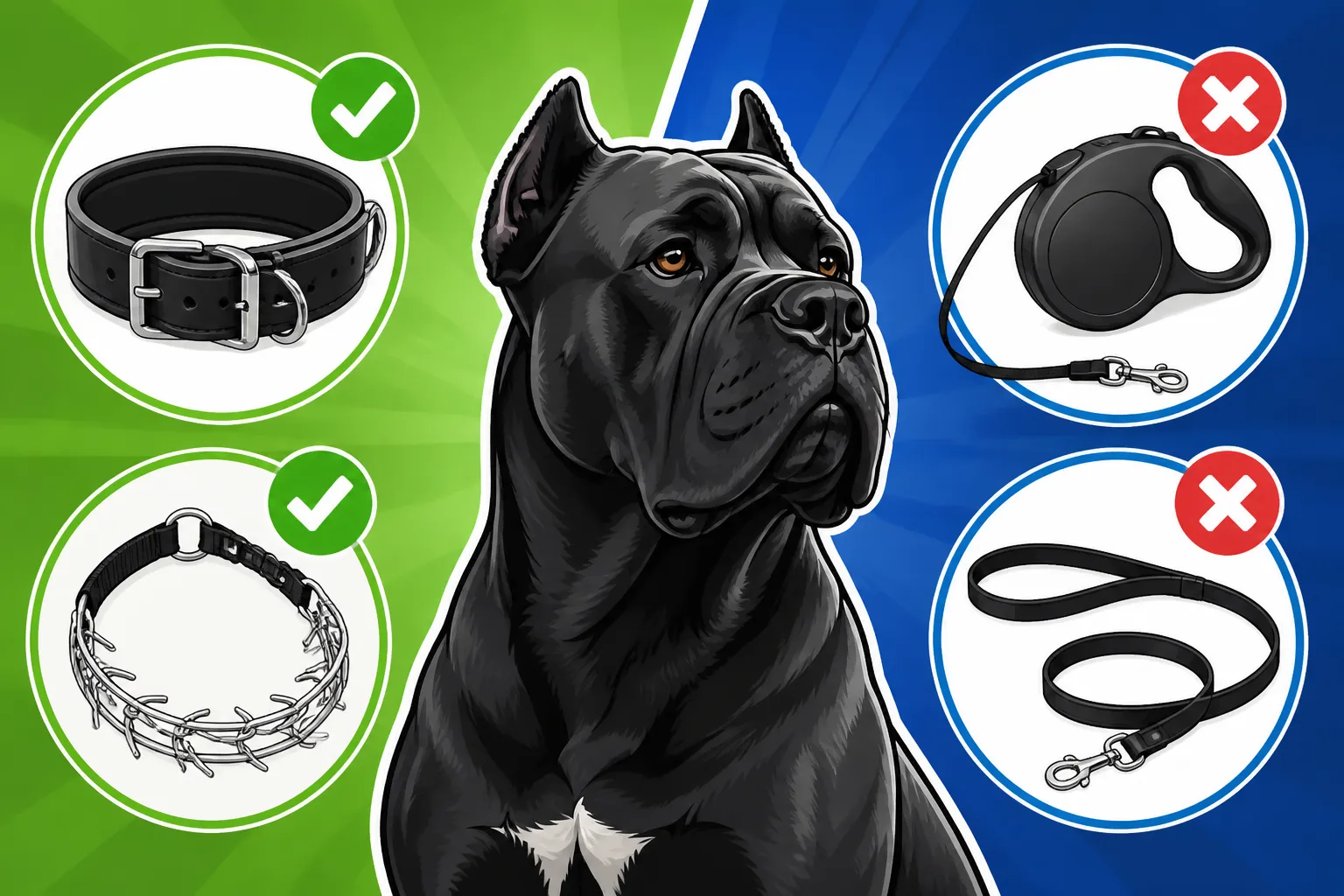
The classic flat buckle collar is what most people picture when they think of a dog collar. They come in various materials, from sturdy nylon to elegant leather, and are primarily used for ID tags, basic restraint, and as a holder for leashes during casual walks. For a Cane Corso, a heavy-duty version with robust hardware is essential. Look for wide straps (at least 1.5 to 2 inches) and strong metal buckles and D-rings.
While perfect for holding identification and vaccination tags, a flat buckle collar offers minimal control for a Cane Corso that pulls. A determined Corso can easily put enough pressure on their trachea to choke themselves, or worse, back out of a loosely fitted one. They are best reserved for situations where your dog is already reliably walking on a loose leash, or for wearing around the house. They are not designed to be primary training tools for a dog that needs help with Loose Leash Walking a Cane Corso Puppy.
Martingale Collars: Gentle Correction for Slipper-Outers
Martingale collars, also known as "no-slip" or "limited-slip" collars, are a fantastic option for Cane Corsos, particularly those with strong necks or a tendency to slip out of traditional buckle collars. They consist of a main loop that goes around the dog's neck and a smaller control loop. When the leash is attached to the D-ring on the control loop and pulled, the main loop tightens evenly around the neck, preventing the dog from backing out without causing choking.
These collars are much gentler than choke chains and are widely recommended by trainers for sighthounds and other breeds with narrow heads and thick necks, a description that often fits a Cane Corso. They provide just enough tension to communicate with your dog without causing harm, making them effective for everyday walks and training. Ensure you get one made from strong, durable materials – nylon webbing is common, but leather or biothane options are also available for added strength and longevity.
Front-Clip Harnesses: Redirecting Pulling Power
Front-clip harnesses have gained immense popularity as a humane way to manage pulling. Instead of clipping the leash to the back, the D-ring is located on the dog's chest. When your Cane Corso pulls, the leash tension gently redirects them to the side, turning their body rather than allowing them to lean into the pull. This effectively lessens their leverage and makes it harder for them to drag you forward.
Many owners find these harnesses incredibly effective for teaching loose leash walking, as they remove pressure from the neck and throat. Brands like BAXTER & Bella, while primarily an online training platform, often recommend and review specific types of front-clip harnesses known for their effectiveness. While generally safe, it's crucial to get a harness that fits well to avoid chafing or restricting shoulder movement, especially for a growing Cane Corso puppy. Pay close attention to the fit around the chest and armpits. For a deeper dive into their effectiveness, you might want to read Whether a Front Clip Harness Stops a Cane Corso Pulling.
Head Halters: Power Steering for Giants
A head halter, sometimes called a head collar or head lead, is like power steering for your Cane Corso. It fits over the dog's muzzle and behind their ears, with the leash attaching under the chin. When your dog pulls, the pressure is applied to their muzzle and the back of their head, gently turning their head to the side, which naturally encourages them to stop pulling and focus on you. This mimics the way a horse is led, providing a surprising amount of control with minimal physical effort.
Head halters are excellent for large, strong dogs where handlers struggle to maintain control with other methods. They don't apply pressure to the throat and are considered a humane training aid. However, some dogs initially resist them because the feeling of something around their muzzle is unfamiliar. Proper introduction, involving positive reinforcement and treats, is key to helping your Cane Corso accept and even enjoy wearing one. Desensitization over several days or weeks will prevent your dog from trying to paw it off.
Prong Collars: Controversial but Effective for Training
Prong collars, also known as herm Sprenger collars after a popular manufacturer, are perhaps the most controversial training tool, yet they can be highly effective when used correctly and humanely by an experienced hand. They consist of metal links with blunted "prongs" that sit against the dog's neck. When tension is applied, the prongs create even pressure around the neck, mimicking a correction from a mother dog's mouth. The key is even pressure, not jabbing or poking.
These collars are designed to give precise, quick feedback without causing pain or airway restriction, unlike a traditional choke chain. For a Cane Corso with serious pulling issues that hasn't responded to other tools, a prong collar can be a game-changer, quickly teaching them to walk politely on a leash. However, they should never be used without guidance from a qualified, balanced trainer who understands their proper application. Incorrect use can cause physical injury, psychological damage, and erode trust between you and your dog. They must be fitted high on the neck, snug, and used with quick, gentle pops, not constant tension. If you're considering this tool, do your research and seek professional help. We delve deeper into this topic in Whether a Prong Collar Is Needed on a Cane Corso.
Electronic Collars (E-Collars): Communication Tools, Not Punishment
Electronic collars, or e-collars, are another tool often misunderstood and misused, but when employed correctly, they can be invaluable communication aids for advanced training, particularly off-leash work and recall for a powerful breed like the Cane Corso. Modern e-collars offer various settings, including tone, vibration, and static stimulation (often called "tap" or "pressure"), which can be adjusted to a level that is barely perceptible to the dog, acting as a clear, consistent signal rather than a punishment.
The goal with e-collar training is to establish a clear communication system, allowing you to reinforce known commands at a distance. For example, when training Building a Cane Corso's Recall From Eight Weeks, an e-collar can be used to gently remind your dog to come back even when distracted. This can be vital for the safety of a Cane Corso, allowing them reliable off-leash freedom in appropriate environments. Like prong collars, e-collars demand professional guidance to ensure they are introduced and used positively and ethically. They are not a shortcut for basic training, but an enhancement for dogs who already understand commands. For more information, consider reading Whether an E Collar Suits a Cane Corso's Threshold.
Here's a quick comparison of these collar types:
| Collar Type | Primary Use | Pros | Cons | Best For |
|---|---|---|---|---|
| Flat Buckle Collar | ID, casual wear | Comfortable, easy to put on | Little control for pulling, easy to slip out of | Already loose-leash trained dogs, home wear |
| Martingale Collar | Preventing escape, gentle correction | Prevents slipping, humane | Still some pulling if not properly trained | Slipper-outers, dogs with strong necks, everyday walks |
| Front-Clip Harness | Stopping pulling, neck safety | Redirects pulling, no neck pressure | Can restrict shoulder movement if ill-fitting | Pullers, dogs with neck sensitivities, teaching manners |
| Head Halter | Maximum control, redirecting focus | Excellent steering, humane, quick results | Requires desensitization, some dogs dislike feeling | Strong pullers, handlers needing maximum control |
| Prong Collar | Precise communication, serious pulling | Highly effective for strong pullers | Requires professional guidance, controversial | Severe pullers, specific training goals with expert help |
| Electronic Collar | Off-leash reliability, distance cues | Excellent for recall, consistent feedback | Requires professional guidance, controversial, can be misused | Advanced training, off-leash reliability in safe areas |
Choosing the Right Lead for Your Cane Corso
The collar is only half the equation; the lead (or leash, as many call it) is equally critical for control and safety. A strong collar is useless if your lead snaps or the clip fails under pressure.
Standard Nylon or Leather Leads: The Workhorses
Your everyday lead will likely be a standard nylon or leather lead, usually 4 to 6 feet in length. For a Cane Corso, "standard" needs to translate to "heavy-duty." Look for leads made from thick, strong webbing or full-grain leather that won't chafe your hands. The hardware is paramount: opt for solid brass or stainless steel clips that are large and sturdy. Cheap pot metal clips can bend or break under the force of a powerful lunge.
Many owners find a 6-foot lead offers the best balance for most walking situations, allowing enough slack for your dog to explore without getting too far ahead. For close-quarters training or city walking, a 4-foot lead can be more appropriate. Some leads feature padded handles, which are a blessing when you're managing a dog that might still be learning Leash Manners Before a Cane Corso Hits Ninety Pounds.
Long Lines: For Safe Exploration and Recall Training
Long lines are exactly what they sound like: extra-long leads, typically ranging from 15 to 50 feet. They are indispensable tools for safe off-leash practice in open, contained areas where you can give your Cane Corso more freedom to roam while still maintaining a physical connection and control. This allows you to practice commands like "come" or "stay" with real-world distractions, gradually building up their reliability.
Using a long line is perfect for situations where you want your Cane Corso to explore a bit more, sniff around, and burn off energy, but it's not safe or appropriate for them to be fully off-leash. Biothane long lines are a personal favorite for many Cane Corso owners because they are incredibly durable, waterproof, and easy to clean – no more soggy, dirty nylon dragging through mud! They are also less prone to tangling than traditional rope leads. If you're serious about your Cane Corso's recall, then Using a Long Line With a Cane Corso should definitely be on your training plan.
Double-Ended Leads: Versatility and Control
Double-ended leads are incredibly versatile and a favorite among trainers and multi-dog households. As the name suggests, they have a clip at both ends and often multiple rings along the length, allowing you to adjust the lead's length or use it in various configurations. For a single Cane Corso, you can clip one end to a front-clip harness and the other to a martingale collar, giving you dual points of contact for enhanced control. This is often recommended when you need maximum steering power for a strong or reactive dog.
Another common use is to clip one end to your dog's collar and loop the lead around your waist, then clip the other end back to the lead itself, creating a hands-free walking experience – just be sure your Cane Corso has excellent leash manners before trying this! Many quality training lines and leads, some even reviewed by platforms like BAXTER & Bella, are designed with this kind of versatility in mind. This type of lead also allows you to easily switch between different training setups without needing multiple pieces of equipment.
Fitting and Using Gear Correctly
Having the right gear is only half the battle; knowing how to properly fit and use it is equally crucial for effectiveness and your Cane Corso's comfort and safety. Ill-fitting equipment can cause discomfort, injury, or simply be ineffective in providing control.
The Two-Finger Rule and Collar Placement
For any collar that goes around your Cane Corso's neck – be it a flat buckle, martingale, or prong collar – the "two-finger rule" is a widely accepted guideline for proper fit. This means you should be able to comfortably slip two fingers between the collar and your dog's neck. If you can fit more, it's too loose and they could slip out or it might not provide adequate feedback. If you can't fit two fingers, it's too tight and could restrict breathing or cause discomfort.
For martingales and prong collars, placement is even more specific. These collars should sit high on your Cane Corso's neck, just behind the ears, rather than resting lower on the base of the neck. This high placement allows for precise communication with minimal effort and prevents the collar from sliding down to a less sensitive area where it would be less effective or even put pressure on the trachea. Always double-check the fit before every walk.
Introducing New Equipment Positively
Imagine someone strapping something new and strange onto your face or neck without explanation. You'd probably be a little wary, right? Your Cane Corso feels the same way about new collars or harnesses, especially head halters or e-collars. Positive introduction and desensitization are key to ensuring your dog accepts new equipment willingly. Start by simply showing your Cane Corso the new item, letting them sniff it. Pair it with high-value treats and praise.
Next, have them wear it for very short periods (a minute or two) in a low-distraction environment, again, paired with treats. Gradually increase the duration, always making it a positive experience. For head halters, some dogs try to paw them off; consistent positive reinforcement and distraction will help them get used to the sensation. Never force new gear onto your dog or use it immediately for a stressful situation. Build a positive association first. This patient approach also applies to training situations like Teaching a Cane Corso to Ignore the Doorbell, where a dog might wear a specific collar for better control.
The Link Between Equipment and Training
It's vital to remember that a collar or lead, no matter how specialized or expensive, is merely a tool. It's an aid to communication, not a magical solution to behavioral problems. The true effectiveness of any piece of equipment is directly linked to the consistent, positive reinforcement training that accompanies it. For example, a front-clip harness can help you stop pulling, but it won't teach your Cane Corso to walk nicely; that comes from repetition, rewards, and clear communication from you.
Think of it like this: a high-quality chef's knife is an incredible tool, but it doesn't automatically make you a great chef. You still need to learn the techniques. Similarly, a prong collar or an e-collar, when used by a professional, can accelerate learning and fine-tune obedience, but only because the underlying training principles are already in place. Without dedicated effort on Loose Leash Walking a Cane Corso Puppy or general obedience, even the best gear will only offer temporary management, not lasting behavioral change. Invest in both good tools and good training.
Practical Considerations for Cane Corso Owners
Beyond the type and fit of the gear, there are several practical factors that Cane Corso owners need to keep in mind to ensure their equipment stands up to the demands of daily life with such a robust dog. Choosing wisely here can save you headaches and money in the long run.
Durability and Materials
When buying any collar or lead for your Cane Corso, durability should be at the absolute top of your priority list. These are powerful dogs, and cheap, flimsy equipment simply won't last – and more importantly, it can fail at a critical moment. Look for heavy-duty materials in every component. For webbing, thick nylon or biothane are excellent choices. Biothane, in particular, is waterproof, stink-proof, and incredibly strong, making it a favorite for active dogs who love water or mud. For leather, choose thick, full-grain options, not bonded or thin fashion leather.
The hardware is equally important. Ensure buckles, D-rings, and leash clips are made from solid metal, such as brass or stainless steel, and are robust in size. Avoid anything that looks thin, stamped, or feels light and hollow, as these are often signs of cheaper materials that will fail. When shopping on platforms like Amazon, pay close attention to reviews mentioning durability for large breeds and examine product photos closely for the quality of the stitching and metal components. Investing a little more upfront in truly heavy-duty gear will prevent the need for frequent replacements and ensure your dog's safety.
Weather and Environment
A Cane Corso is an active dog, and their equipment needs to be suitable for various weather conditions and environments. If you live somewhere with frequent rain or enjoy walks near water, waterproof materials like biothane for leads and certain synthetic collars are a game-changer. They won't absorb water, get heavy, or develop mildew smells. For early morning or late evening walks, especially with a dark-coated Cane Corso, reflective stitching on collars and leads can significantly improve visibility and safety in low light conditions.
Consider the climate as well. In hot, humid weather, a harness made of breathable material might be more comfortable for extended wear than a thick leather collar. Conversely, in colder temperatures, ensure any metal components won't get excessively cold to the touch or cause discomfort. Thinking about how your daily routine interacts with the elements will help you select gear that keeps your Cane Corso comfortable and safe, no matter the forecast.
Cost Versus Value
It's tempting to opt for the cheapest option when faced with the initial costs of Cane Corso ownership, but with collars and leads, this can be a false economy. A cheap collar or leash that breaks after a few weeks, or worse, fails during a critical moment, could end up costing you far more in stress, potential vet bills, or even liability if your dog gets loose. Instead, view your investment in quality gear as a long-term commitment to safety and effective training.
A well-made, durable collar or lead from a reputable brand might cost more upfront, but it will withstand the strength and enthusiasm of your Cane Corso for years. Many owners find that once they've found a robust lead and collar they trust, they rarely need to replace them. This isn't just about saving money on replacements; it’s about providing consistent, reliable control and preventing dangerous situations. Prioritize value, safety, and longevity over the lowest price point when outfitting your magnificent Cane Corso.
Ultimately, finding the perfect collar and lead for your Cane Corso is a journey. It involves understanding your dog's individual temperament, your own handling skills, and your training goals. Whether you opt for the gentle redirection of a front-clip harness, the precision of a head halter, or the clear communication of a prong or e-collar under professional guidance, remember that the equipment is an extension of your leadership and commitment to your dog. Paired with consistent, positive training, the right gear will empower you to safely and confidently enjoy every moment with your loyal Cane Corso.
Disclaimer
This article is for general informational purposes only and does not constitute professional advice. Laws, prices and regulations vary by location and change over time. Consult a qualified professional for guidance on your specific situation.