Teaching a Cane Corso to Accept a Delivery Driver
It's a familiar scenario for many Cane Corso owners: the doorbell rings, or you hear the tell-tale rumble of a delivery truck, and suddenly your calm, stately companion transforms into a roaring, lunging guard dog. That intense reaction to delivery drivers, whether it's the mail carrier, the parcel service, or the food delivery, isn't just startling; it can be genuinely stressful for everyone involved, often leading to strained interactions with essential service providers. This guide will walk you through practical, empathetic strategies to help your Cane Corso learn to accept and even ignore delivery drivers, making your doorstep a more peaceful place for everyone.
Understanding Your Cane Corso's Instincts at the Door
Before we can effectively address your Cane Corso's reactions, it's crucial to understand why they behave the way they do. These aren't just random acts of naughtiness; they're deeply rooted in the breed's history and genetic makeup.
The Guardian Mindset
Your Cane Corso sees themselves as a protector of your home and family, whether you asked them to or not. This isn't a fault; it's a feature. They were bred for centuries in Italy to guard farms, livestock, and their people, often without direct command. When a delivery driver approaches, especially one they don't know, it's not a friendly visit in your dog's eyes. It's an intrusion into their territory by a stranger. They perceive this person, often dressed in a uniform and carrying packages, as a potential threat to their "pack" and their property. Their barking, growling, and sometimes even lunging are their way of saying, "Stop! You are too close to my territory, and I am here to protect it." This instinct is incredibly strong and often hardwired, making it challenging to counter without consistent and understanding training. They're not being aggressive out of malice, but out of a profound sense of duty.
The Problem with Unmanaged Reactivity
Allowing your Cane Corso's reactivity to go unchecked can lead to a host of problems that extend beyond just annoying the delivery driver. For starters, every time your dog barks and the driver leaves (which they always do), your dog learns that their barking works. It's a self-reinforcing cycle: bark, stranger leaves, dog feels successful. This strengthens the unwanted behavior. Over time, this can escalate from barking to lunging, nipping, or even actual bites, creating a dangerous situation for both the driver and your dog. Beyond the physical risks, chronic reactivity is incredibly stressful for your Cane Corso. Imagine constantly feeling like you have to defend your home multiple times a day. That level of adrenaline and anxiety takes a toll, potentially impacting their overall health and well-being. It can also sour your relationship with your dog, as you might start dreading every delivery, leading to frustration rather than connection. Plus, in the age of online shopping, delivery drivers are a constant presence, making this an issue that won't just go away on its own.
Laying the Foundation: Early Training and Socialization
Addressing delivery driver reactivity isn't just about what happens at the door; it's about building a solid foundation of trust, exposure, and obedience from puppyhood.
Importance of Neutral Exposure
One of the biggest mistakes owners make is isolating their Cane Corso puppies, thinking they're protecting them. While protecting their health with vaccines is crucial, waiting too long to expose them to the world in a neutral way can be detrimental. Your Cane Corso puppy needs to see, hear, and experience a vast array of sights, sounds, smells, and people during their critical socialization window, which typically closes around 16 weeks of age. This isn't about letting everyone pet your puppy; it's about creating positive or, at the very least, neutral associations.
Think about taking your puppy to a busy park, a hardware store that allows dogs, or even just sitting outside a coffee shop. The goal is for them to observe people, including those who look different (uniforms, hats, large packages), from a safe distance without feeling pressured to interact. You want them to learn that these things exist and are not inherently threatening. A dog that has only ever seen a handful of people will naturally be more suspicious of a new one. A Cane Corso puppy introduced to a variety of situations will develop better coping mechanisms and be less likely to react with fear or aggression later on. A great resource for foundational training and early exposure, even if you don't have a puppy, can be found in online programs like those offered by BAXTER & Bella, which emphasize positive socialization. Remember, it's about quality exposure, not just quantity. The Socialization Window a Cane Corso Puppy Gets is absolutely vital for setting them up for success.
Basic Obedience for Impulse Control
Strong basic obedience is the bedrock of managing a reactive Cane Corso. Commands like "sit," "stay," "down," and especially "place" are not just party tricks; they are tools for impulse control and redirection. When your dog has a solid "place" command, you can send them to their designated spot – a bed or mat – and they'll understand they need to stay there until released, regardless of what's happening at the front door. This gives you control over the situation and prevents the immediate rush and bark.
Start training these commands in low-distraction environments and gradually increase the difficulty. Practice "place" when someone walks past the window, then when a family member comes to the door, eventually working up to a real delivery. Reward heavily with high-value treats when they hold their "place" despite the distraction. This teaches them that calm behavior in the face of a perceived "threat" earns them wonderful things. An effective "place" command can genuinely save your sanity and make your home a more predictable environment. The Place Command That Saves a Cane Corso Household can transform your home life, and Teaching a Cane Corso to Hold a Place Cot offers specific guidance.
Specific Strategies for Delivery Driver Encounters
Once you have a good foundation, you can start applying more targeted strategies directly related to those delivery moments.
Managing the Approach and Knock
The key to preventing an explosion of barking is to interrupt the sequence before your Cane Corso reaches their threshold. This means being proactive. If you know a delivery is coming (thanks to tracking apps) or if you see a delivery truck pull up, get ahead of your dog's reaction.
- Doorbell Desensitization: Many dogs react violently to the doorbell itself. You can desensitize them by playing doorbell sounds at a very low volume throughout the day, pairing it with treats and calm praise. Gradually increase the volume over weeks, always keeping it positive. The goal is for the doorbell to predict a treat, not an intruder. Teaching a Cane Corso to Ignore the Doorbell covers this in more detail.
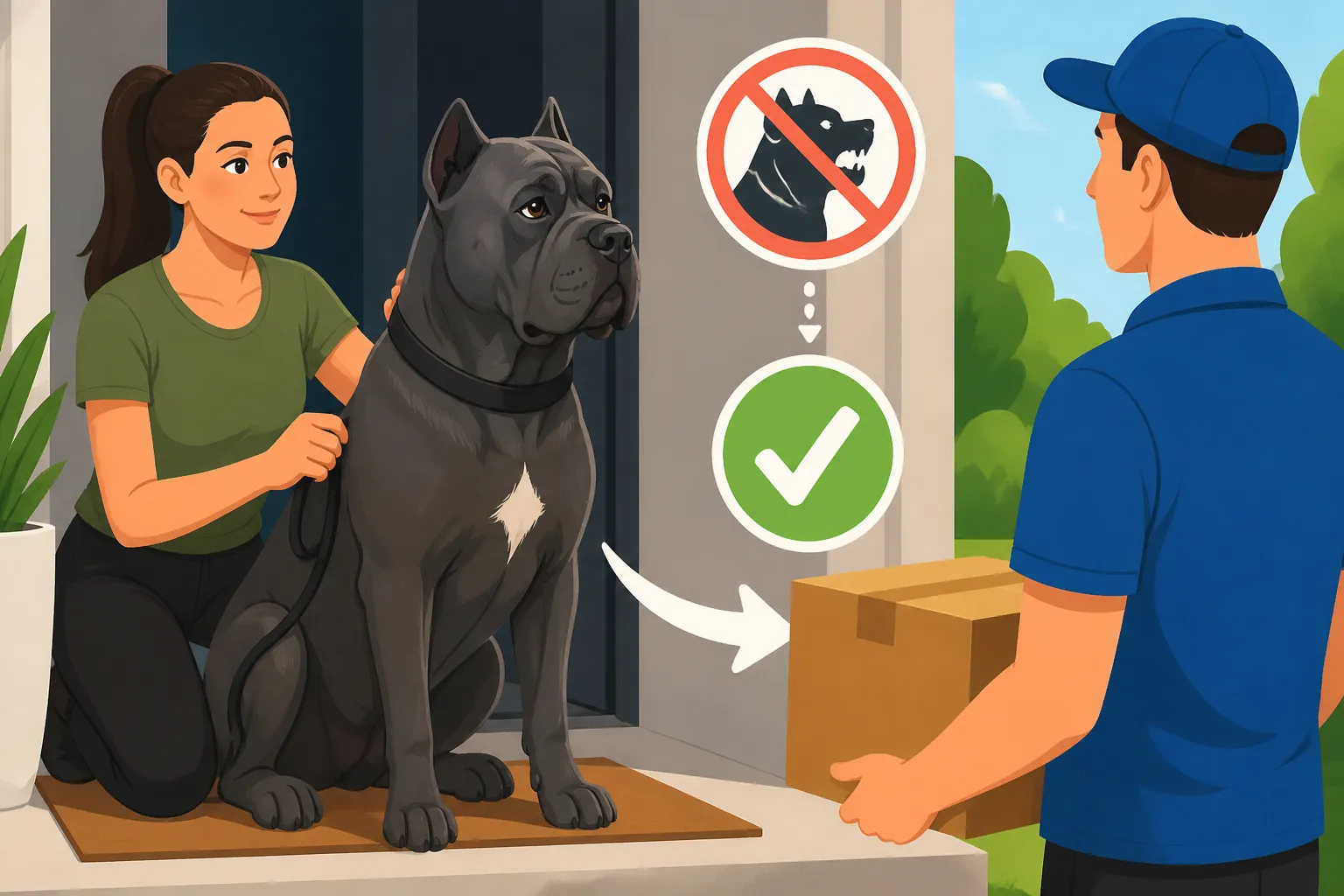
- Controlled Setup: Have your dog on a leash when you anticipate a delivery, even if they're usually off-leash indoors. This gives you immediate control. As the driver approaches, try to create distance. If your front door opens directly into your living space, use a baby gate to create a barrier a few feet back, giving you space to manage your dog without them feeling they must confront the person. You can find sturdy pressure-mounted baby gates on Amazon that can hold up to a determined Cane Corso.
- Redirection: As soon as you hear a sign of the driver, redirect your dog's attention to you. Ask for a "sit" or "down," and immediately reward them before they start to bark. If they do start to bark, calmly interrupt the behavior and guide them to their "place" with a leash if necessary.
Creating a "Safe Zone" for Your Dog
A "safe zone" is a designated area where your Cane Corso can go and feel secure, away from the immediate stressor of the front door. This could be their crate, a specific dog bed in another room, or a "place" cot. The idea is to teach them that when the doorbell rings, their job is to go to their safe zone, not to guard the door.
- Crate Training: A properly crate-trained Cane Corso views their crate as a den, a quiet retreat. If your dog is comfortable in their crate, you can direct them there when a delivery arrives. Give them a long-lasting chew or a puzzle toy to occupy them while the driver is at the door.
- "Place" Command: As discussed, a solid "place" command is invaluable. Practice sending them to their "place" every time someone comes to the door, whether it's a family member or a delivery driver. They should remain there until released. This is a crucial management tool to prevent them from rehearsing unwanted behaviors.
- Physical Barriers: For dogs with high arousal, sometimes a physical barrier is best. A sturdy baby gate, strategically placed, can keep your Cane Corso a safe distance from the door while still allowing them to observe (if observation doesn't trigger reactivity). If observation does trigger them, a solid door or moving them to a room further away might be necessary. Having a visual barrier can significantly reduce their immediate stress response.
Positive Reinforcement and Desensitization
The ultimate goal is to change your Cane Corso's emotional response to delivery drivers from alarm to neutrality, or even positive anticipation. This is where positive reinforcement and systematic desensitization come in.
- Pairing with Positives: Every time a delivery driver approaches, before your dog starts to react, start giving them high-value treats. The sound of the truck, the sight of the uniform – these cues should predict deliciousness, not danger. If you have a smart doorbell, you can practice this with notification sounds. As soon as you get an Amazon notification, for example, start dropping treats.
- Controlled Exposure (Staged Deliveries): This is where you might need a friend or a trusted trainer. Have them dress like a delivery driver and approach your house in a controlled manner.
- Phase 1: Distance. Have them walk by your house at a distance your dog notices but doesn't react to. Reward your dog for calm observation.
- Phase 2: Approach. Gradually have your friend approach closer, perhaps to your driveway, then your walkway. Each time your dog remains calm or is easily redirected, reward heavily.
- Phase 3: Door Interaction. Eventually, have your friend approach the door, knock, and even leave a package. During this, your dog should be on "place" or behind a gate, being continuously rewarded for staying calm.
- Treat Scatter: If your dog is food motivated, a treat scatter can be highly effective. As the delivery driver approaches, quickly scatter a handful of small, high-value treats on the floor. This encourages your dog to sniff and search, diverting their attention and engaging their brain in a positive way instead of fixating on the door. This changes the association from "intruder!" to "treasure hunt!"
Advanced Techniques and Addressing Persistent Issues
Sometimes, despite your best efforts, the delivery driver dilemma persists. This is when it's time to consider more advanced strategies or professional help.
Working with a Trainer or Behaviorist
If your Cane Corso's reactivity is severe, involves aggression, or simply isn't improving with your efforts, don't hesitate to seek professional guidance. A qualified dog trainer or certified veterinary behaviorist can offer tailored strategies and hands-on help.
- Understanding Expertise: Look for a trainer who uses positive reinforcement and force-free methods. Avoid anyone who suggests dominance-based techniques, as these can actually exacerbate reactivity and damage your relationship with your powerful Cane Corso. A good trainer will observe your dog's specific triggers and body language and develop a personalized plan. What a Behaviorist Charges for a Reactive Cane Corso can give you an idea of the investment, but it's often worth every penny for peace of mind.
- Real-World Application: A professional can help you practice with real-world scenarios or even play the role of the delivery driver, guiding you through the timing of rewards and interventions. They can also help identify any underlying anxieties or fears contributing to the reactivity that might need a different approach. They can also ensure that The Handler a Cane Corso Respects is you, not just them.
Tools and Aids for Management
While tools are never a substitute for training, they can be invaluable aids in managing and safely training a reactive Cane Corso.
| Tool Category | Description | How it Helps with Delivery Drivers |
|---|---|---|
| Management Barriers | Baby gates, exercise pens, crates, solid doors | Creates physical distance and prevents direct confrontation. |
| Leashes/Collars | Flat collars, harnesses (front-clip for less pull), head halters, long lines | Provides physical control and redirection away from the door. |
| Muzzles | Basket muzzles (e.g., Baskerville) | Ensures safety for delivery drivers during training or if reactivity is severe. Allows you to focus on training without fear of a bite. |
| Enrichment Toys | Puzzle feeders, Kongs, Lickimats, long-lasting chews | Distracts and occupies the dog with a positive activity during deliveries. |
| Smart Doorbells | Ring, Google Nest Doorbell | Alerts you early, allowing you to prepare and manage your dog before the driver arrives. Can also be used for desensitization training. |
| High-Value Treats | Cooked chicken, cheese, hot dogs, specific training treats (e.g., Zuke's) | Essential for positive reinforcement and creating positive associations. |
- Muzzles: For a Cane Corso with severe reactivity or a bite history, a basket muzzle is a crucial safety tool. It allows you to continue training and exposure without the risk of someone getting hurt. Muzzle training should always be introduced positively, making the muzzle a comfortable and even desirable item. Why Every Cane Corso Should Be Muzzle Trained Early is a topic every guardian breed owner should explore. Learning Fitting a Basket Muzzle on a Cane Corso correctly is also important for comfort and effectiveness.
- Long Lines: If you are practicing outside in a safe, enclosed area and your dog is reacting to people passing by, a long line (15-30 feet) can give them a sense of freedom while still allowing you to manage their proximity and recall them if needed. This is helpful for practicing neutral observation at a distance. Using a Long Line With a Cane Corso can be a game-changer for control.
- Smart Doorbells: Devices like Ring or Google Nest Doorbell can be a lifesaver. They notify you when someone is approaching your door, giving you precious seconds to implement your management strategy before the actual knock or ring triggers your Cane Corso. This proactive approach is far more effective than reacting after the fact.
Remember, consistency is paramount when training a Cane Corso. These intelligent dogs thrive on routine and clear expectations. Every interaction with a delivery driver is a training opportunity, so make sure you're consistently reinforcing the desired calm behavior. It might take time, patience, and a lot of high-value treats, but with dedication, you can teach your Cane Corso to be a calm, confident presence at the door, rather than a frantic guardian.
Disclaimer
This article is for general informational purposes only and does not constitute professional advice. Laws, prices and regulations vary by location and change over time. Consult a qualified professional for guidance on your specific situation.