Whether the Cane Corso and the Neapolitan Share an Ancestor
It’s easy to look at a majestic Cane Corso and then gaze upon a grand Neapolitan Mastiff and wonder if they’re cut from the same cloth. Their sheer size, imposing presence, and undeniable Italian heritage often lead people to ask if these two powerful breeds share a common lineage. This guide will delve into the fascinating historical tapestry of these magnificent dogs, exploring their shared ancient roots and the distinct paths they took to become the beloved breeds we know today.
The Ancient Roman Molossers: A Common Starting Point
Before we talk about specific breeds, we need to talk about their great-grandparents, or perhaps, their ancient ancestors. Long before Italy was unified, and even before these breeds had their current names, there were formidable dogs spread throughout the Roman Empire. These were the "Molossers," a general term for large, powerfully built guardian dogs believed to have originated from the ancient kingdom of Molossia in Epirus (modern-day Greece and Albania).
Tracing Back to the Canis Pugnax
The Canis Pugnax, or Roman War Dog, is often cited as the foundational ancestor for many of the large, guardian breeds that exist today, particularly those from Italy. Imagine the Roman legions, conquering vast territories, and needing dogs for protection, for war, and even for entertainment in arenas. These weren't a single, uniform breed in the modern sense with a strict standard, but rather a functional type of dog – large, muscular, brave, and extremely protective. They were bred for their ability to guard, to fight, and to deter threats, making them invaluable assets to Roman society. They were the dogs that marched with soldiers, guarded villas, and protected livestock. The Roman War Dog Behind the Cane Corso perfectly encapsulates this foundational ancestor.
These dogs were incredibly adaptable and their traits were prized. So, as the Roman Empire expanded, so too did the presence of these powerful canines. They weren't pets in the way we think of them today; they were working animals, vital for survival and security in a tumultuous era. Their lineage spread far and wide, laying the genetic groundwork for many future breeds across Europe, especially in the regions that remained under Roman influence for centuries.
How Roman Dogs Spread Across the Empire
The Romans were master builders, strategists, and colonizers, and their influence stretched across Europe, North Africa, and the Near East. Wherever Roman legions established outposts, built roads, or settled, their culture and their animals followed. This included their dogs. Picture Roman camps, supply lines, and newly established farms; these places all needed protection. The dogs were an integral part of this infrastructure. They provided security against both human and animal threats, guarded property, and perhaps even served as companions to soldiers and settlers.
Over generations, these "Roman dogs" interbred with local dogs, adapting to different climates, terrains, and specific working needs. In Italy itself, these dogs continued to evolve, diverging based on the specific demands of the region. Some areas needed agile hunters or farmhands, while others required imposing guardians for vast estates. This constant adaptation, selection, and breeding for specific tasks meant that while the foundational DNA remained, distinct types began to emerge. The Roman Molossers the Cane Corso Descends From explores this direct lineage in more detail. It’s this shared ancient heritage that firmly links the Cane Corso and Neapolitan Mastiff back to a common, albeit distant, ancestral pool.
Divergent Paths in Italian History
While both the Cane Corso and the Neapolitan Mastiff share the illustrious heritage of the ancient Roman Molosser, their stories began to diverge significantly in the centuries following the Roman Empire's decline. Italy, a land of diverse geography and culture, shaped these dogs into two distinct, yet equally magnificent, breeds.
The Cane Corso: A Lighter, More Agile Farm Dog
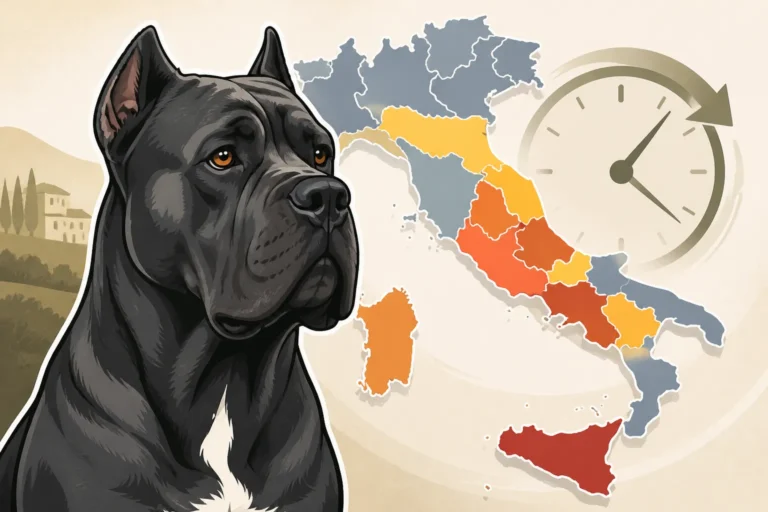
The Cane Corso, often referred to as the "working man's dog" or the "farmer's dog," predominantly developed in the southern Italian regions, particularly Puglia and Basilicata. Here, life was often hard, and a dog needed to be versatile, intelligent, and capable of a wide range of tasks. The Cane Corso was bred for agility, speed, and strength, traits essential for its demanding roles. They were used to guard livestock from predators like wolves and bears, drive cattle to market, and protect farmsteads from intruders. They were active participants in daily farm life, needing to move quickly and decisively.
Imagine a farmer needing a dog that could track wild boar through rough terrain, hold a bull for castration, or guard the family home from opportunistic thieves. This required a dog that was physically athletic, mentally sharp, and possessed a keen guardian instinct without being overly aggressive unless provoked. The Cane Corso's physique reflects this: a powerful, muscular, yet less bulky build than its Mastiff cousin, allowing for greater speed and endurance. Their history is deeply tied to the Guarding the Masseria in Southern Italy, where their work was indispensable.
The Neapolitan Mastiff: A Heavier Estate Guardian
In contrast, the Neapolitan Mastiff (or Mastino Napoletano) evolved primarily in the Campania region, around the city of Naples. This area was characterized by large, often wealthy estates and villas that required an imposing, formidable deterrent to protect property and family. The Neapolitan Mastiff's role was less about agile, active work and more about a static, powerful presence. They were bred to be truly intimidating, with their massive size, heavy bone structure, and distinctive loose skin, which served as protection in fights.
These dogs were living fortresses, designed to guard with an unwavering presence. Their sheer size and deep, resonating bark were often enough to deter any would-be intruder. Unlike the Cane Corso, which needed to be able to cover ground quickly, the Neapolitan Mastiff's job was often to patrol a more confined area, projecting an air of unshakeable guardianship. Their massive head, often wrinkled face, and droopy eyes contribute to their unique and ancient look, harkening back to imagery of powerful dogs from antiquity. The selection pressures for the Neapolitan Mastiff favored extreme mass and a profoundly protective, often more reserved, temperament.
Physical Characteristics and Temperament Reflecting Their Paths
The divergence in their historical roles profoundly influenced the physical characteristics and temperaments that define the Cane Corso and the Neapolitan Mastiff today. While both are impressive, powerful breeds, their individual traits tell the story of their distinct evolutionary paths.
Comparing the Cane Corso's Build and Drive
The Cane Corso embodies the ideal of a powerful, athletic guardian. When you look at a Cane Corso, you see a dog built for action. Their body is muscular, well-defined, and their frame is generally leaner and more agile compared to the Neapolitan. They have a relatively shorter muzzle, giving them a more "sporty" appearance, and their overall structure allows for explosive bursts of speed and remarkable endurance. A healthy Cane Corso should be powerful but not cumbersome. The Chest and Body a Cane Corso Standard Describes outlines these athletic features, crucial for their working heritage.
Temperamentally, Cane Corsos possess a higher drive and are often more engaged with their environment. They are typically very intelligent and eager to please their owners, making them highly trainable, though they absolutely require consistent and confident leadership. Their guardian instinct is paramount, but it's typically expressed through alert observation and a readiness to act if a threat is perceived. They bond deeply with their families and are often described as "velcro dogs" indoors, always wanting to be close. However, their exterior presence and deep, powerful bark are usually enough to make strangers think twice. What a Cane Corso Would Actually Do With an Intruder gives further insight into their protective nature.
Contrasting with the Neapolitan's Mass and Mellow Nature
The Neapolitan Mastiff, on the other hand, is the epitome of a massive, imposing guardian, often described as a "gentle giant" with its family, but a formidable presence to strangers. Their most striking feature is their sheer size and abundant loose skin, which hangs in characteristic folds around their head, neck, and body. This heavy skin, combined with their dense bone structure, gives them a ponderous, almost ancient, look. Their gait is typically slow and rolling, reflecting their mass rather than agility. They are not built for speed or endurance, but for sheer presence and deterrent power. The Cane Corso Against the Neapolitan Mastiff further highlights these visual differences.
In terms of temperament, Neapolitan Mastiffs are generally more placid and watchful. While intensely loyal and protective of their family, they tend to be less overtly "driven" than a Cane Corso. They often prefer to observe and assess, making a quiet but strong statement through their presence alone. Their guarding is often more passive but incredibly effective. They can be wary of strangers and may take time to accept new people. They are not known for high-energy antics; instead, they are content to be near their family, often napping or simply observing the household. This more reserved nature doesn't mean they are less protective; it simply manifests differently, relying on their awe-inspiring appearance as a primary line of defense. The Height a Cane Corso Should Measure can also be compared to the even greater mass of a Neapolitan.
Modern Breed Recognition and Continued Distinctions
The journey from ancient Molosser to distinct modern breeds for the Cane Corso and Neapolitan Mastiff has been long and winding, marked by periods of decline and passionate revival. Today, both are recognized and cherished breeds, each with their own dedicated enthusiasts and standards.
Separate Paths to Recognition
Both breeds faced near extinction after the World Wars, as industrialization and societal changes made their traditional roles less common. However, dedicated enthusiasts in Italy recognized the importance of preserving these living historical artifacts.
The Neapolitan Mastiff was the first to experience a significant revival. In the 1940s, Italian artist Piero Scanziani discovered remaining examples of the ancient Mastino type in rural areas around Naples and initiated a breeding program. His efforts were instrumental in establishing the modern Neapolitan Mastiff, leading to its official recognition by the Italian Kennel Club (ENCI) in the mid-20th century. The focus was on preserving the massive, heavy-boned guardian type that had been a fixture of Neapolitan estates for centuries.
The Cane Corso's revival came a bit later, in the 1970s. A group of enthusiasts, led by Dr. Paolo Breber, embarked on a quest to find the remaining examples of the old working farm dogs in the remote regions of southern Italy. They sought out dogs that fit the description of the ancient "Corso" type – agile, versatile, and devoted guardians. Their dedicated breeding program brought the Cane Corso back from the brink, leading to its recognition by ENCI in 1994. The American Kennel Club (AKC) later recognized the Cane Corso in 2010, placing it in the Working Group. The 2010 AKC Recognition of the Cane Corso marked a significant milestone for the breed. These separate revival efforts underscore their distinct identities, even with shared ancestry.
Why They Are Considered Separate Breeds
Despite their shared distant ancestry with the Roman Molossers, the Cane Corso and Neapolitan Mastiff are unequivocally considered separate breeds today. This distinction is based on several key factors:
Firstly, distinct breed standards have been developed for each. These standards meticulously define everything from ideal size, weight, and proportion to head shape, coat color, and temperament. While both standards emphasize guardian instincts and loyalty, the specifics of their desired physical characteristics and temperament traits are quite different. For instance, the Cane Corso standard emphasizes an athletic, functionally powerful build, while the Neapolitan Mastiff standard highlights mass, heavy bone, and extensive loose skin. What the Standard Says a Cane Corso Should Look Like applies specifically to the Cane Corso, with the Neapolitan having its own, equally detailed standard.
Secondly, their historical roles and geographical development created different dogs. One was bred for active, agile work across farms and fields; the other for an imposing, static deterrent on estates. These different demands led to physical and temperamental selection pressures that steered them onto different evolutionary paths.
Finally, their breeding programs in the modern era have focused on maintaining these distinctions. Breeders of Cane Corsos strive to produce dogs that embody the breed's athleticism and keen working drive, while Neapolitan Mastiff breeders focus on preserving the breed's massive size, distinctive appearance, and noble, watchful temperament. While both possess immense loyalty and a protective nature, the way these traits manifest, and the physical forms they take, are unique to each breed. This is why, when you see them side by side, there's no mistaking a Cane Corso for a Neapolitan Mastiff, even with their shared historical echoes.
To help visualize some of these key differences, here's a brief comparison:
| Feature | Cane Corso | Neapolitan Mastiff |
|---|---|---|
| Origin | Southern Italy (Puglia, Basilicata) | Campania, Italy (around Naples) |
| Historical Role | Versatile farm dog, hunter, livestock guardian | Estate and property guardian, deterrent |
| Build | Athletic, powerful, muscular, less loose skin | Massive, heavy-boned, abundant loose skin/wrinkles |
| Muzzle | Shorter, broader | Very broad, deep, often with significant dewlap |
| Gait | Agile, free-moving | Rolling, ponderous, heavy |
| Energy Level | Moderate to high, requires consistent exercise | Low to moderate, prefers lounging but needs walks |
| Temperament | Alert, intelligent, driven, eager to work | Watchful, placid, imposing, highly protective |
| Common Colors | Black, gray, fawn, red, brindle | Gray (blue), black, mahogany, tawny, brindle |
This table clearly illustrates that while they stem from a common ancient ancestor, their independent development has created two magnificently distinct breeds, each with their own unique beauty and purpose.
Disclaimer
This article is for general informational purposes only and does not constitute professional advice. Laws, prices and regulations vary by location and change over time. Consult a qualified professional for guidance on your specific situation.