Whether the Cane Corso Counts as a Mastiff
It’s a question that often pops up in conversations among dog enthusiasts and even long-time Cane Corso owners: does the Cane Corso actually count as a Mastiff? The confusion is completely understandable. With their impressive size, powerful build, and ancient lineage as formidable guardians, it's easy to lump them into the "mastiff" category. However, the answer is a little more nuanced than a simple yes or no. This comprehensive guide will dive deep into the history, physical characteristics, temperament, and official classifications to help you understand precisely where the Cane Corso fits into the world of large dog breeds.
Understanding the Term "Mastiff"
Before we can definitively answer whether the Cane Corso is a Mastiff, we need to clarify what the term "Mastiff" actually signifies. It’s not just a casual descriptor for any big, strong dog. The word itself carries a rich history and has evolved to mean different things in different contexts, which is a major source of the widespread confusion.
Historical Roots of Mastiff-Type Dogs
Historically, "mastiff" was a much broader term, essentially referring to any large, powerfully built dog used for guarding, hunting, or warfare. Imagine ancient Rome, where powerful, heavy-boned dogs were crucial for military campaigns, protecting homesteads, and even gladiatorial contests. These dogs were not necessarily a single, uniform breed but rather a type selected for their sheer strength, imposing presence, and protective instincts. They were the original working giants, valued for their ability to deter threats and defend their charges with unwavering loyalty. This ancestral group, often referred to as "Molossers," laid the groundwork for many of the massive breeds we know today. The term "Molosser" itself comes from the Molossian hound of ancient Greece, a now-extinct breed known for its substantial build and guarding prowess. So, in this very ancient, broad sense, the ancestors of the Cane Corso certainly fit the historical "mastiff-type" description, sharing a common heritage with many other large, guardian breeds. The Roman Molossers the Cane Corso Descends From offers more insight into these early canine protectors.
The Modern "Mastiff" as a Specific Breed
Fast forward to the present day, and the word "Mastiff" has a much more specific meaning within the world of dog breeding and kennel clubs. When capitalized, "Mastiff" almost universally refers to the English Mastiff, a distinct and ancient breed. This is the dog often pictured in historical paintings, known for its immense size, wrinkled brow, and generally calm, docile demeanor (at least, when not provoked). The English Mastiff is a recognized breed with its own unique standard, history, and characteristics. It’s important to differentiate this specific breed from the general "mastiff-type" descriptor. To illustrate, think of "terrier" – it can refer to a type of dog, but also specific breeds like the "Boston Terrier" or "Yorkshire Terrier." Similarly, while many dogs might be considered "mastiff-type" due to their build and role, only one is formally known as the Mastiff.
What the Term "Molosser" Means
To truly understand the Cane Corso's classification, it's essential to grasp the term "Molosser." As mentioned, Molossers are a category of solidly built, large dog breeds that share common ancestry with the ancient Molossian hounds. This group includes a wide array of dogs, often characterized by their strong bones, muscular bodies, relatively short muzzles (though this can vary), and protective instincts. Think of breeds like the Cane Corso, Neapolitan Mastiff, Bullmastiff, Dogo Argentino, and yes, the English Mastiff. All of these breeds fall under the Molosser umbrella. They were historically developed for tasks requiring strength, courage, and guardian capabilities, whether that was guarding livestock, protecting property, or serving in battle. The Cane Corso is unequivocally a Molosser. This classification is broader than "Mastiff" (the breed) but more specific than "mastiff-type" (the ancient descriptor). It acknowledges their shared heritage and physical characteristics without forcing them into the exact mold of a single breed like the English Mastiff. The FCI (Fédération Cynologique Internationale), a global canine organization, actually groups many of these breeds together under "Molossoid breeds," which further solidifies this distinction.
The Cane Corso's Ancient Lineage
The Cane Corso's story is a captivating journey through history, deeply intertwined with the human need for protection and assistance. Understanding its specific lineage helps to clarify why it stands as its own distinct breed, even while sharing an ancient connection to other powerful canines.
Descendants of Roman War Dogs
The Cane Corso's roots stretch back to ancient Roman times, making it a direct descendant of the canis pugnax, the powerful Roman war dogs. These formidable canines were not only used in battle but also as guardians of villas and livestock. They were dogs of immense power and courage, perfectly suited for the demanding and often dangerous work required of them. After the fall of the Roman Empire, while many breeds declined or vanished, the ancestors of the Cane Corso persisted in the remote regions of southern Italy, particularly in Puglia. Here, they were not merely pets, but vital working members of the family and farm. The Roman War Dog Behind the Cane Corso offers a fascinating deep dive into this history. Unlike the English Mastiff, which was developed in Britain with its own specific lines, the Cane Corso developed in Italy, adapting to the unique needs of its region.
The Cane Corso's Role in Italian Farming Life
In Italy, particularly in the masserias (fortified farmsteads), the Cane Corso became indispensable. They were true general-purpose farm dogs. Their duties were incredibly varied and demanding. They guarded property, keeping watch over homes, fields, and barns. They were also crucial for driving livestock, including cattle and pigs, acting more like a "cattle dog" or "drover" than a typical herding breed, using their presence and strength to manage large animals. Perhaps most impressively, they were utilized as boar hunters, holding the formidable wild boars at bay for the hunter. This required not just immense strength, but also agility, keen intelligence, and unwavering courage. This hands-on, active working role shaped the Cane Corso's physique and temperament, making them more athletic, agile, and reactive than many of the larger, more sedentary Mastiff breeds. Their historical job wasn't just to look intimidating; it was to do work. You can read more about their original purpose in The Farm Job the Cane Corso Was Kept For.
Revival and Recognition of the Breed
By the mid-20th century, following the devastating effects of World War II and the modernization of farming practices, the Cane Corso faced near extinction. They were a breed largely unknown outside of their native Italian regions, and their numbers dwindled significantly. Thankfully, a group of dedicated Italian enthusiasts, spearheaded by men like Dr. Paolo Breber, embarked on a mission in the 1970s to find and revive the remaining specimens of the breed. This intensive effort involved searching remote farmsteads and carefully selecting dogs that embodied the historical characteristics of the Cane Corso. Their dedication brought the breed back from the brink. Paolo Breber and the Men Who Brought the Cane Corso Back tells this incredible story. The breed gained official recognition in Italy by the ENCI (Italian National Kennel Club) in 1994, and later, through the efforts of dedicated American breeders, the Cane Corso was recognized by the American Kennel Club (AKC) in 2010, joining the Working Group. The 2010 AKC Recognition of the Cane Corso details this significant milestone. This distinct revival and separate recognition solidify its status as a breed apart from the English Mastiff, even within the broader Molosser family.
Physical Characteristics: Comparing the Cane Corso to the Mastiff
When you see a Cane Corso next to an English Mastiff, the differences, while subtle to the untrained eye, become quite apparent. While both are undeniably large and powerful, their specific builds, proportions, and overall aesthetics reflect their distinct historical purposes.
Size, Stature, and Build Differences
The most immediate difference often lies in sheer bulk. The English Mastiff is renowned for being one of the largest and heaviest dog breeds in the world, often described as a "gentle giant." They possess an undeniably massive, heavy-boned frame, with a broad chest and a substantial, thick-set body. Imagine a true behemoth, built for imposing presence and sheer weight. Their movement is often described as ponderous or slow, reflecting their size.
The Cane Corso, while still a very large and muscular breed, is decidedly more athletic and agile. They have a more refined, yet still powerful, bone structure. Their bodies are leaner, more proportioned for speed and maneuverability, reflecting their history as active working dogs that needed to drive cattle and hunt boar. A well-conditioned Cane Corso will display clearly defined musculature rather than just bulk. They possess a long, powerful stride, capable of covering ground quickly. The Height a Cane Corso Should Measure will give you specific details on their standard size. While a male English Mastiff can easily exceed 200 pounds and stand over 30 inches tall, a male Cane Corso typically weighs between 100-120 pounds and stands 25-27 inches tall, a significant difference in mass.
Head Shape and Muzzle Proportions
Both breeds possess impressive heads, but their features differ. The English Mastiff is characterized by a massive, broad, and somewhat flattened skull with pronounced wrinkling on the forehead, especially when alert. Their muzzle is relatively short and broad, often contributing to a square-faced appearance. They also tend to have more prominent flews (pendulous lips) and a noticeable dewlap (loose skin under the throat).
The Cane Corso's head is also large and powerful, but it’s more proportional to its body, conveying strength without excessive bulk. Their skull is broad but less domed than some mastiffs, and the planes of the skull and muzzle are generally parallel. The muzzle is robust, deep, and notably longer than that of the English Mastiff, typically being about one-third the length of the head. This longer muzzle, combined with a strong scissor or reverse scissor bite, reflects its working past where a strong grip was essential. While they can have some wrinkles, they are not as pronounced as those on an English Mastiff. The Head a Cane Corso Judge Wants to See provides a detailed look at the ideal Cane Corso head. Their overall expression is one of alertness and intelligence, rather than the placid gravity of the English Mastiff.
Coat and Color Variations
Both breeds have relatively short coats, but there can be subtle differences in texture and a broader range of colors in the Cane Corso.
The English Mastiff typically has a short, straight, coarse outer coat with a dense, shorter undercoat. Their standard colors include fawn, apricot, or brindle, always with a dark mask around the muzzle and eyes.
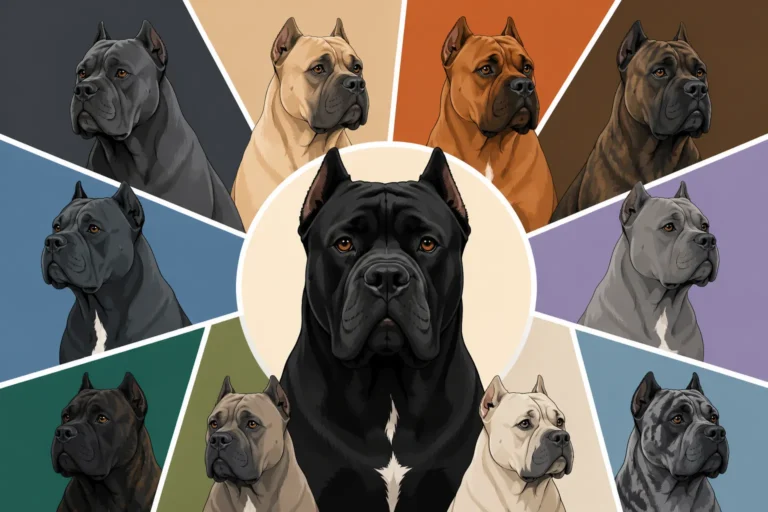
The Cane Corso also boasts a short, stiff, glossy coat with a light undercoat that becomes thicker in colder climates. Their color palette is more diverse and includes black, gray (often called blue), fawn, and red, with or without brindle markings. They also have a distinctive black or gray mask, which is a required trait in the breed standard. You can learn more about these variations in Every Color a Cane Corso Is Allowed to Be. While both might appear solid-colored, the specific shades and the presence or absence of brindle patterns often differ, further distinguishing them. Furthermore, the overall tight skin and lack of excessive wrinkles on the Cane Corso contrast with the more profuse skin and folds seen on the English Mastiff.
Here's a quick comparison of key physical traits:
| Feature | Cane Corso | English Mastiff (The Mastiff Breed) |
|---|---|---|
| Overall Build | Athletic, muscular, powerful, agile | Massive, heavy-boned, bulky, imposing |
| Weight (Adult) | Typically 100-120 lbs (Males) | Typically 160-230 lbs (Males), can be more |
| Height (Adult) | Typically 25-27 inches (Males) | Typically 30+ inches (Males) |
| Head Shape | Broad but proportionate, less wrinkled | Very broad, massive, pronounced wrinkling |
| Muzzle Length | Robust, deep, approximately 1/3 of head | Relatively short, broad, square |
| Skin/Flews | Tighter skin, less prominent flews/dewlap | Profuse skin, heavy flews, noticeable dewlap |
| Coat Texture | Short, stiff, glossy, light undercoat | Short, straight, coarse, dense undercoat |
| Colors | Black, gray, fawn, red (with/without brindle) | Fawn, apricot, brindle (always with dark mask) |
| Temperament | Active, alert, highly protective, intelligent | Calm, docile, loyal, protective, often reserved |
Temperament and Working Role: Distinctions in Purpose
Beyond physical appearance, the core differences between the Cane Corso and the English Mastiff become even clearer when we look at their historical working roles and the temperaments these roles fostered. These aren't just cosmetic variations; they speak to the very essence of each breed.
The Cane Corso as an Active Guardian
The Cane Corso's temperament is a direct reflection of its past as a highly active, all-purpose farm and hunting dog in Italy. They are intense, intelligent, and possess a formidable drive to work and protect. A Cane Corso isn't content to simply sit by and look imposing; they need a job, mental stimulation, and consistent physical exercise to be truly balanced. Their protective instincts are finely tuned and incredibly strong, making them exceptional guardians of their family and property. They are alert, observant, and reactive when necessary, meaning they are quick to assess situations and act if they perceive a threat. This reactivity is not aggression, but rather a keen awareness and willingness to engage.
This breed thrives on having a clear purpose and a strong, consistent leader. They form incredibly strong bonds with their family but can be reserved, aloof, or even suspicious of strangers if not properly socialized from a young age. Their intelligence means they learn quickly, but also that they can be manipulative if an owner isn't firm and fair. You can learn more about their disposition in The Character a Cane Corso Judge Expects in the Ring. For Cane Corso owners, managing this powerful protective drive means constant vigilance and training. They need ongoing socialization, not just as puppies, but throughout their lives, to ensure they distinguish between friend and foe accurately. This intense commitment to their duties is part of what makes them such effective and loyal guardians.
The English Mastiff's More Laid-Back Nature
In stark contrast, the English Mastiff, while certainly protective, tends to have a much more laid-back, docile, and gentle temperament. Historically, their role was more about deterrence through sheer size and presence rather than active engagement. They were guardians of estates, relying on their imposing stature to discourage intruders. They are often described as "nanny dogs" with their families, particularly with children, exhibiting patience and a calm demeanor.
While they will certainly protect their family if a threat is genuine, their initial instinct is often less reactive than a Cane Corso's. They are generally less demanding in terms of constant activity and mental stimulation, preferring a comfortable spot on the couch over a rigorous working session. Their exercise needs are moderate, and they are not typically known for the same level of agility or sustained energy as a Cane Corso. They are often more accepting of strangers once properly introduced, though they maintain a dignified reserve. Their size alone is usually enough to make a statement, and they tend to move with a stately, deliberate pace rather than the Cane Corso's more active gait.
Instinctual Differences in Protection
The fundamental difference in their protective instincts stems from their historical roles. The Cane Corso was bred to actively engage with threats, whether it was driving off rustlers, holding a wild boar, or intervening in a potentially dangerous situation. Their protection is active, physical, and often confrontational. This means they need owners who are experienced in managing such a powerful drive and who can channel it responsibly through consistent training and appropriate outlets.
The English Mastiff, on the other hand, typically offers a more passive form of protection. Their size is a deterrent in itself. While they are brave and will defend their loved ones, their method of protection often involves blocking, standing guard, or using their voice rather than the immediate, physical intervention a Cane Corso might employ. They are formidable but generally less inclined to direct conflict unless absolutely necessary. This difference is crucial for potential owners to understand, as it dictates the type of home, training, and lifestyle each breed requires. For example, a dedicated Cane Corso owner might look for specific training equipment on Chewy to support their dog's active lifestyle, whereas a Mastiff owner might prioritize orthopedic beds.
Classification and Breed Grouping
Understanding how official kennel clubs categorize breeds can shed a lot of light on the "Mastiff" question. These classifications are not arbitrary; they reflect a breed's history, function, and genetic relationships.
The AKC Working Group and the Cane Corso
In the United States, the American Kennel Club (AKC) classifies breeds into various groups based on their historical function. The Cane Corso is proudly placed in the Working Group. This group is home to breeds that were developed to perform specific tasks, such as guarding property, pulling carts, or performing search and rescue. Other breeds in the AKC Working Group include the Doberman Pinscher, Rottweiler, Great Dane, Boxer, and yes, the Mastiff (English Mastiff).
The inclusion of the Cane Corso in the Working Group alongside the English Mastiff shows that while they share the general "working dog" characteristic, they are recognized as distinct breeds within that umbrella. The AKC's designation recognizes the Cane Corso's heritage as an active guardian and utility dog. This group emphasizes their intelligence, strength, and trainability for tasks, rather than just their appearance. This placement acknowledges their powerful build and protective nature, but still differentiates them as a unique breed with its own specific standard and history. How the Cane Corso Reached the AKC Working Group explains this journey in detail.
FCI Classification and Molosser Types
Globally, the Fédération Cynologique Internationale (FCI) has a slightly different, but equally informative, classification system. The FCI divides breeds into ten groups. The Cane Corso falls under Group 2: Pinscher and Schnauzer – Molossoid Breeds – Swiss Mountain and Cattle Dogs. Within this group, it is further categorized under Section 2.1, "Molossoid, Mastiff type."
This is where some of the confusion originates! The FCI specifically labels the Cane Corso as a "Mastiff type" within the Molossoid group. This designation is not saying the Cane Corso is the English Mastiff breed, but rather that it belongs to the broader category of Molossoid dogs that exhibit characteristics typically associated with the historical "mastiff type" – i.e., large, powerful, guardian dogs. Other breeds in this "Mastiff type" section include the Bullmastiff, Dogue de Bordeaux, and the Neapolitan Mastiff (which the FCI recognizes as Mastino Napoletano). This classification clearly indicates that the Cane Corso shares a common ancient lineage and general physical characteristics with these large, imposing breeds, without being the specific breed known as "the Mastiff."
Why the "Mastiff" Label Isn't Always Straightforward
The inherent ambiguity of the term "Mastiff" is why this question is so frequently asked.
- Historical vs. Modern Usage: In historical terms, "mastiff" was a functional description for a type of dog. In modern breed terms, "Mastiff" (capitalized) refers to a specific breed: the English Mastiff. The Cane Corso is a Molosser, and indeed a "mastiff-type" dog in the ancient, general sense, but it is not the Mastiff breed.
- Molosser Family: Understanding the Molosser family is key. It's a broad category, and both the Cane Corso and the English Mastiff are members, but they are distinct cousins within that family, not the same dog. Think of it like a family tree: all are "canine," some are "molossers," and then you have individual branches like "Cane Corso" and "English Mastiff."
- Regional Development: The Cane Corso developed in Italy for specific Italian farm tasks. The English Mastiff developed in England for its own regional roles. Their separate geographical and functional development led to distinct physical and temperamental traits, even if they share distant ancestry. For example, comparing a Cane Corso to The Cane Corso Against the Neapolitan Mastiff shows specific differences even within Italian Molossers.
Debunking Misconceptions
The "Mastiff" question isn't just about semantics; it touches on common misunderstandings that can affect how people perceive and interact with the Cane Corso. Clearing up these misconceptions is vital for responsible ownership and accurate public perception.
"All Big Dogs are Mastiffs"
This is perhaps the most pervasive and understandable misconception. When people encounter a truly massive dog – particularly one with a broad head and muscular build – their immediate assumption is often "Mastiff." This generalization ignores the incredible diversity within large dog breeds. While a Great Dane, a Newfoundland, a Saint Bernard, and a Cane Corso are all undeniably large dogs, they are distinct breeds with unique histories, temperaments, and physical characteristics.
The Cane Corso, with its imposing presence, often falls victim to this blanket categorization. However, as we've discussed, its athletic build, longer muzzle, and active guardian temperament set it apart from the more ponderous English Mastiff. To assume all large, powerful dogs are "Mastiffs" is akin to saying all small, fluffy dogs are "Poodles." It overlooks the intentional breeding, the specific standards, and the unique contributions each breed has made. Education is key here. Understanding the term "Molosser" as a broader category that encompasses many different "mastiff-type" breeds can help people appreciate the individuality of each one.
The Implication of the "Mastiff" Name for Breed Specific Legislation
This misconception can have serious, real-world consequences for Cane Corso owners. In some areas, "Mastiff" is unfortunately used as a generic term in breed-specific legislation (BSL), which restricts or bans certain breeds due to perceived dangerousness. If a municipality simply lists "Mastiffs" as a restricted breed, and the Cane Corso is mistaken for or grouped under this general term, owners can face severe challenges, from increased insurance premiums to outright bans.
While most well-written BSL specifies breeds by their official names (e.g., "Pit Bull types," "Rottweiler," "Doberman Pinscher," or "Mastiff" referring specifically to the English Mastiff), the ambiguity can lead to enforcement issues. An uneducated official or neighbor might mistakenly identify a Cane Corso as "a Mastiff" and cause unnecessary problems for the owner. It’s a constant battle for Cane Corso enthusiasts to educate the public and local authorities about their breed's distinct identity to prevent such misidentification. Owners often need to carry documentation and be prepared to explain their dog's breed and temperament. This is why it is so important to distinguish the Cane Corso as its own unique breed, a Molosser, but not the Mastiff breed.
Understanding Breed Standards vs. General Appearance
A breed standard is a detailed description of the ideal specimen of a breed, developed by the national breed club and recognized by kennel clubs like the AKC. It covers everything from physical appearance (size, coat, head shape, bite) to temperament and movement. These standards are meticulously crafted to preserve the unique characteristics of each breed.
The Cane Corso has its own distinct breed standard, which describes an athletic, powerful, and agile guardian. What the Standard Says a Cane Corso Should Look Like delves into this. While it shares some general "molosser" traits with the English Mastiff – such as a powerful build and a large head – the specific details in their respective standards highlight key differences. For instance, the Cane Corso standard emphasizes its strong, proportionate muzzle and active temperament, while the English Mastiff standard focuses on its massive bulk and dignified demeanor.
When evaluating whether a Cane Corso "counts as a Mastiff," it’s crucial to look beyond a superficial general appearance and consult these official breed standards. They provide the definitive answers, showcasing that while they belong to the same overarching family of Molossers, the Cane Corso is a distinct breed with its own specific set of characteristics, history, and purpose. It's a powerful, magnificent breed in its own right, not merely a variant of another.
Disclaimer
This article is for general informational purposes only and does not constitute professional advice. Laws, prices and regulations vary by location and change over time. Consult a qualified professional for guidance on your specific situation.