Teaching a Cane Corso Puppy to Give Things Up
It's a scene most Cane Corso owners know well: your adorable, but already formidable, puppy has snatched something it absolutely shouldn't have – your reading glasses, a dropped pill, or even that mystery object from under the couch. The stakes are high with a powerful breed like ours, and the natural instinct to snatch it back can quickly escalate into a tense standoff. This guide is here to walk you through teaching your Cane Corso puppy the crucial "give" command, turning potential emergencies into calm exchanges and fostering a relationship built on trust, not tug-of-war.
Why "Give" is Non-Negotiable for a Cane Corso
Bringing a Cane Corso into your home means preparing for a dog that will grow into a magnificent, strong, and highly intelligent companion. Their mouths are their primary way of exploring the world, especially as puppies, and their jaws are incredibly powerful. This combination means that teaching a reliable "give" command isn't just about good manners; it's a fundamental safety measure that will serve both of you for a lifetime.
Beyond Just Retrieving: It's About Safety
Imagine your puppy, still small but with surprisingly strong jaws, chewing on a favorite squeaky toy. Now, picture them suddenly snatching a dropped AA battery from the floor, or maybe a small, sharp piece of plastic from a broken toy. With a smaller breed, you might have a moment to react, but a Cane Corso can swallow things with alarming speed and efficiency. Their size and strength mean that what might be a minor inconvenience for a Chihuahua is a genuine veterinary emergency for a Cane Corso. A swallowed battery can cause severe internal burns, while sharp objects can perforate internal organs. Teaching "give" early means you have a tool to prevent these terrifying scenarios before they even have a chance to develop. It's about giving you control in a potentially dangerous situation, protecting your puppy from accidental harm, and protecting your peace of mind.
Furthermore, a dog that knows and trusts the "give" command is less likely to develop resource guarding issues down the line. Resource guarding, where a dog becomes possessive over items, food, or even people, is a serious behavioral problem that can be incredibly challenging, and sometimes dangerous, to manage with a large, powerful breed. By teaching your Cane Corso that giving something up always leads to a positive outcome – usually something even better – you are building a foundation of trust and cooperation. This proactive approach helps to prevent the defensiveness and anxiety that often fuel guarding behaviors, ensuring a more harmonious household for everyone.
The Foundation for Future Training
The "give" command is far more than just getting your dog to drop an item. It's a foundational piece of impulse control and cooperation, teaching your Cane Corso puppy that working with you is rewarding. This basic premise carries over into almost every other aspect of their training journey. Think about it: if your puppy understands that giving up a coveted item results in a win, they're more likely to offer other desired behaviors, like coming when called (recall), waiting at a doorway, or walking politely on a leash without pulling.
For a Cane Corso, a breed renowned for its intelligence and strong will, establishing this cooperative relationship from a young age is paramount. These dogs grow incredibly fast, and their physical strength can quickly outpace an owner who hasn't laid a solid groundwork of obedience and mutual respect. A puppy that learns early to engage willingly with commands, even when it means giving up something it wants, is far more likely to be a well-mannered and responsive adult. This early work means that when you ask your 100-pound adult Cane Corso to "give" a stick on a walk, they don't see it as a challenge to their authority, but rather an opportunity for a reward or a new interaction with you. It sets the stage for a lifetime of successful communication and a clear understanding that you are the benevolent leader who provides all good things. The Structure a Cane Corso Needs Every Single Day really starts with these small, consistent lessons.
Starting with the Basics: Introducing the "Give" Command
You want to make "give" a game, not a demand. The key is to start with low stakes, high rewards, and always make it a positive experience. Remember, your Cane Corso puppy is a blank slate, and every interaction contributes to their understanding of the world and their place in it.
The Swap Game: Making "Give" a Positive Experience
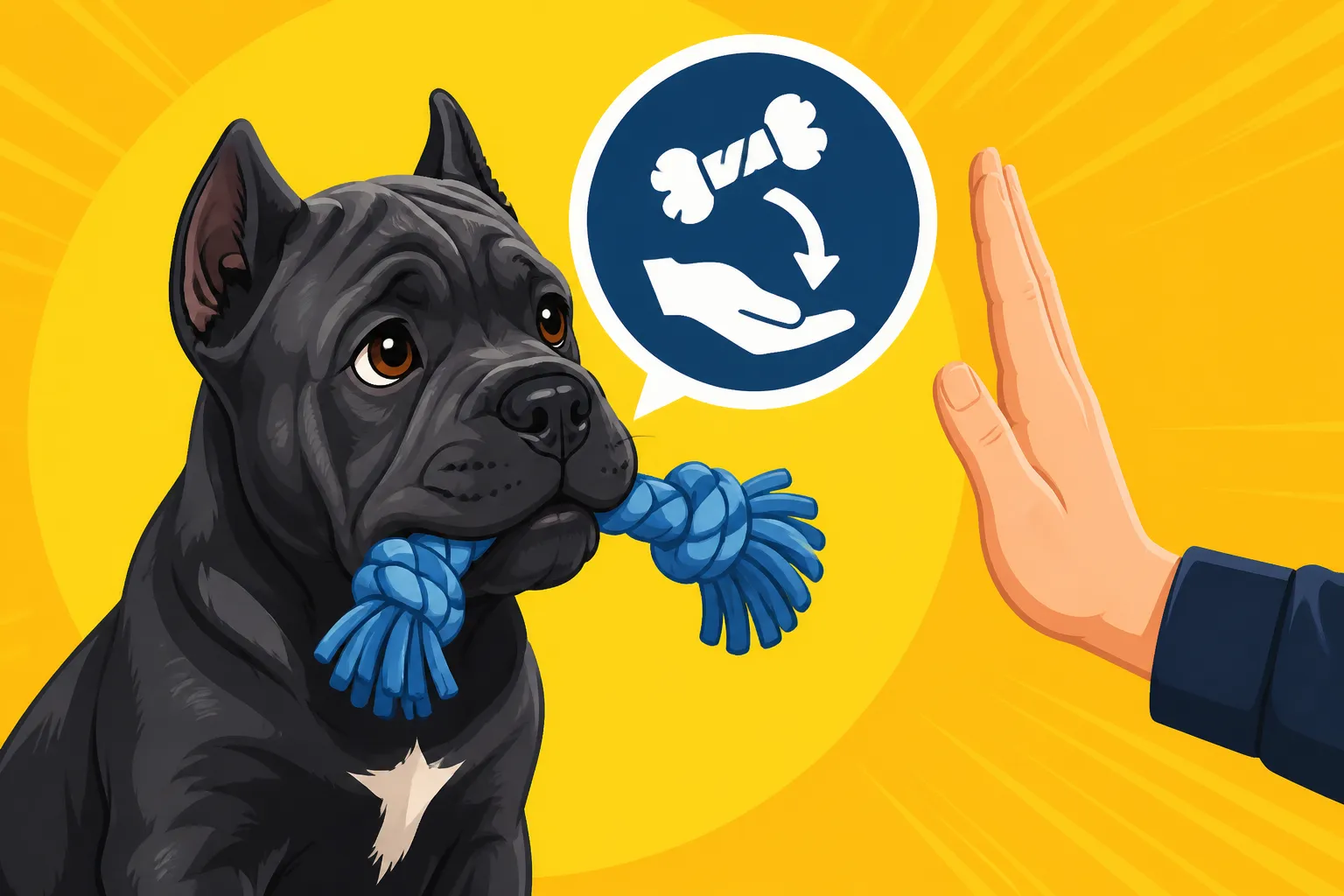
The swap game is the gold standard for teaching "give." It leverages your puppy's natural desire for things and turns it into a training opportunity. You'll need two main things: a selection of low-value items your puppy is likely to pick up but won't be overly possessive about (think old socks, empty plastic bottles, safe puppy toys they don't adore) and some incredibly high-value treats (think tiny pieces of cooked chicken, cheese, or hot dogs).
Here's how you play:
- Start Simple: Sit on the floor with your puppy. Offer them one of the low-value items. Let them take it into their mouth and chew on it for a moment.
- Introduce the Swap: With a high-value treat clearly visible in your hand, bring it to your puppy's nose. As they sniff the treat, they'll likely open their mouth to investigate. The moment the low-value item drops from their mouth, say your "give" command in a cheerful, calm voice.
- Reward and Release: Immediately give them the high-value treat and lavish them with praise ("Good give!"). Then, after they've enjoyed the treat, you can even give them back the original item or offer another low-value toy to keep the game going. This teaches them that giving something up doesn't mean it's gone forever; it often means something better is coming.
- Repeat, Repeat, Repeat: Do this several times in short, positive sessions throughout the day. Keep the sessions fun and stop before your puppy gets bored or frustrated. The goal is to build a strong positive association with the word "give" and the act of releasing an item.
The beauty of this method is that it avoids any confrontation. You're not prying their mouth open or snatching items away, which can easily lead to fear, defensiveness, or resource guarding in a powerful breed. Instead, you're teaching them that your hands are a source of good things, and that releasing an item is always a positive choice on their part. For more on positive reinforcement, you might find The Reward a Cane Corso Actually Values helpful in finding what truly motivates your pup.
Increasing Value and Distraction
Once your Cane Corso puppy is reliably swapping low-value items for treats, it's time to gradually increase the difficulty. This means introducing items they value more and practicing in more distracting environments.
First, start upping the value of the items you ask them to "give." If they're good with socks, try a slightly more exciting toy, then maybe a favorite chew. The trick here is to ensure your high-value treat always outweighs the value of the item they're currently holding. If they're clutching their absolute favorite, indestructible chew, you might need something truly irresistible, like a piece of cooked steak, to make the swap appealing. If you try to swap and they hesitate or ignore the treat, the item they have is too high-value for that particular treat, or you've moved too fast. Go back to an easier item or find a better treat.
Next, gradually introduce distractions. Start in a quiet room, then move to a slightly busier area of the house, perhaps when another family member is quietly in the room. Eventually, you can try practicing in the yard or even on a leashed walk in a low-distraction area. The more diverse environments you practice in, the more solid their understanding of the command will be, and the more reliable they will be when it truly counts. Getting a Cane Corso to Respond the First Time is all about this kind of consistent practice across different scenarios.
It’s also helpful to vary the type of reward. While food is often the strongest motivator, sometimes a brief game of fetch with another toy, a good scratch behind the ears, or enthusiastic verbal praise can also be excellent rewards. Observe your Cane Corso to see what they value most. Are they super toy-motivated? Does a particular squeaky toy get them excited? Or are they entirely food-driven? Understanding their personal preferences will make your training sessions much more effective. Remember, your Cane Corso is still teething and exploring, so make sure they have plenty of appropriate items to chew on. What a Cane Corso Puppy Should Be Given to Chew offers some great suggestions for safe and satisfying options.
| Item Value (Puppy Perspective) | Swap Reward (Your Goal) | Training Environment |
|---|---|---|
| Low (sock, empty paper towel roll) | High-value treat (chicken, cheese) | Quiet, no distractions |
| Medium (non-favorite toy, old slipper) | Very high-value treat (steak, liverwurst) | Mild distractions (another person in room) |
| High (favorite toy, forbidden household item) | Extremely high-value treat or favorite game | Moderate distractions (yard, quiet park) |
| Emergency (dropped medication, hazardous item) | Any available treat, immediate removal of danger | High distractions, critical situation |
Troubleshooting Common Challenges and Advanced Scenarios
Even with the best intentions and the most delicious treats, training a Cane Corso puppy has its moments. They are intelligent, yes, but they can also be stubborn, and their natural instincts are strong. Addressing challenges early and effectively is key to maintaining progress.
When Your Cane Corso Puppy Guards an Item
Resource guarding is a natural, instinctual behavior for many dogs, and it manifests as a dog protecting something they perceive as valuable from others. With a Cane Corso, due to their size and potential for serious harm, it's a behavior that needs careful, non-confrontational management from day one. If your Cane Corso puppy starts showing signs of guarding – freezing, stiffening their body, growling, snapping, or trying to block you from getting close to an item – it’s a clear signal that your current approach needs adjustment.
The absolute most critical rule when encountering resource guarding is to never punish your dog for it. Punishment, like scolding them, prying an item out of their mouth forcefully, or asserting "dominance," will almost always backfire. It teaches your dog that your approach is the threat, making them even more likely to guard in the future, and potentially escalating their defensive behaviors. Why Dominance Methods Backfire on a Cane Corso explains this in more detail.
Instead, go back to basics, but amplify your rewards. If your puppy is guarding a toy, approach slowly and from a distance, tossing incredibly high-value treats near them, but not at them. The goal is to create a positive association with your presence when they have something valuable. Slowly, as they relax, you can move closer, always continuing to toss treats. Only when they are consistently relaxed and happy to see you approach while they have an item can you reintroduce the swap game, starting with very low-value items again, ensuring your treat is always superior. If the guarding behavior is pronounced or escalating, do not hesitate to seek help from a certified professional dog trainer or behaviorist who specializes in positive reinforcement and force-free methods. This is one area where expert guidance can make all the difference in managing a powerful breed.
Preventing Unwanted Chewing and Swallowing
Cane Corso puppies, like all puppies, go through intense chewing phases. This isn't just about exploring; it's also about teething. During The Chewing Stage a Cane Corso Goes Through, their mouths are often uncomfortable, and chewing helps alleviate that sensation. The problem arises when they chew on, or worse, swallow, inappropriate items. Given their strong jaws, they can destroy objects quickly, leading to ingestion risks.
The first line of defense is rigorous puppy-proofing. Imagine your home from your Cane Corso's perspective, which is often much lower to the ground. Secure cabinets, move small objects off low tables, put away shoes, secure electrical cords, and make sure household chemicals are completely out of reach. If it can fit in their mouth, or be broken into pieces that can fit in their mouth, assume they will try to chew it. For outdoor access, ensure your yard is free of tempting, dangerous items like small rocks, toxic plants, or discarded trash.
The second part is providing an abundance of appropriate chew toys. These should be durable and sized for a growing Cane Corso. Look for heavy-duty rubber toys, strong nylabones, or puzzle feeders that dispense treats. Brands like Kong and Nylabone offer products specifically designed for power chewers, which you can easily find on Amazon. Rotate these toys to keep things interesting. A bored Cane Corso is a destructive Cane Corso, so ensuring they have engaging outlets for their chewing instincts is crucial. Without proper exercise and mental stimulation, they will find their own, often undesirable, ways to entertain themselves. What Happens to an Under Exercised Cane Corso can give you more insight into this.
Finally, supervision is absolutely non-negotiable, especially during the teething months. When you can't actively supervise your puppy, they should be in a safe, puppy-proofed area like a crate or a confined space with only appropriate toys. Crate Training a Cane Corso That Outgrows Every Crate is an excellent resource for managing this space effectively. This prevents them from practicing undesirable behaviors and developing dangerous habits.
Integrating "Give" into Daily Life
Consistency and integration are what turn a practiced command into a reliable life skill. "Give" shouldn't just be something you do in a formal training session; it should be part of your everyday interactions with your Cane Corso.
Think of opportunities throughout the day to ask for "give." When your puppy brings you a toy to initiate play, ask for "give" before you throw it again. This is a perfect, low-stakes scenario where the reward (restarting the game) is immediate and clear. If they pick up a leaf in the yard, ask for "give" before they munch on it. Keep a pouch of treats handy, even during casual interactions, so you're always prepared to reward good behavior.
Making it a casual, positive part of your routine reinforces the command without making it feel like a chore for either of you. Many online platforms, such as BAXTER & Bella online puppy school, provide structured programs that help owners integrate training into daily life, offering guides and live support for commands like "give." These resources can be incredibly helpful for maintaining consistency and getting fresh ideas.
For example, when preparing dinner, if your Cane Corso puppy decides your dropped napkin is a new toy, a calm "give!" followed by a high-value treat makes that napkin-snatching less appealing next time. Over time, your puppy will learn that your "give" command means good things happen, regardless of what they are holding. This also supports other impulse control exercises, like Teaching a Cane Corso to Ignore the Doorbell, which requires them to give up their urge to react.
Beyond the Puppy Stage: Maintaining "Give" with an Adult Cane Corso
Just because your Cane Corso is no longer a clumsy puppy doesn't mean you can stop reinforcing the "give" command. In fact, a reliable "give" is arguably even more important with an adult Cane Corso, who has the strength and size to do far more damage, both to themselves and to objects, if they grab something inappropriate.
Consistency is Key for a Growing Dog
As your Cane Corso grows, their focus might shift, and their motivations can change. What was once an irresistible treat might become mundane. This is why consistent reinforcement of the "give" command throughout their adolescence and into adulthood is so vital. Keep practicing the swap game occasionally, even if it's just once a week. Use it as a fun refresher during play sessions. Always keep your rewards high-value and varied to maintain their interest.
Remember, a Cane Corso will continue to "fill out" and mature past their first birthday, often up until they are two years old. During this period, they are still learning and developing their impulse control. Their sheer size and strength mean that any lapse in training or consistency can have greater consequences. By continuing to integrate "give" into your daily life, you are not only reinforcing a command but also reaffirming your leadership and the strong bond of trust you've built. An adult Cane Corso that reliably responds to "give" is a testament to dedicated training and a dog that is safer and more pleasant to live with. This long-term commitment mirrors the dedication needed for Building a Cane Corso's Recall From Eight Weeks all the way through their life.
Handling Emergency "Give" Situations
The true test of a solid "give" command often comes in an emergency. Picture this: you're on a walk, and your adult Cane Corso snatches a half-eaten chicken bone from the ground, or, even worse, picks up something truly toxic like rat poison. This is where those countless positive "give" sessions pay off.
In such a high-stress situation, your reaction is critical. Resist the urge to panic, shout, or try to forcefully remove the item from their mouth. This will likely trigger their instinct to guard and swallow quickly. Instead, remain as calm as possible and immediately offer your highest value treat right to their nose. Say "give!" in a calm, firm voice, then praise and reward the instant the item drops. If they drop the chicken bone, the reward needs to be better than that chicken bone. This might mean pulling out a piece of cooked meat you saved for special occasions.
If they don't immediately drop it, try again with an even more enticing treat, or try to lure them a few steps away from the item with treats while calmly repeating "give." If the item is swallowed, assess the situation immediately. If it's something potentially life-threatening, do not hesitate to call your emergency vet on the way to the clinic. Time is of the essence, and you need to be prepared to provide as much information as possible about what was ingested. A strong "give" can prevent many of these emergencies, but knowing when to act fast is just as important.
Disclaimer
This article is for general informational purposes only and does not constitute professional advice. Laws, prices and regulations vary by location and change over time. Consult a qualified professional for guidance on your specific situation.