Whether a Guardian Breed Like the Cane Corso Goes Off Leash
It's a dream for so many of us, isn't it? That picture-perfect moment of our majestic Cane Corso gracefully loping through a sun-dappled field, coming back instantly with a joyful wag whenever we call. But for those of us who actually live with these powerful, intelligent, and fiercely loyal guardians, we know the reality is often much more complex. The question of whether a guardian breed like the Cane Corso can truly be trusted off-leash is one that weighs heavily on every responsible owner, because their incredible instincts, while beautiful, also come with very real responsibilities and potential challenges. This guide is here to walk you through what it truly takes, the risks involved, and how to approach off-leash work with your Cane Corso realistically and safely.
Understanding the Cane Corso's Core Nature
Before we even begin to discuss off-leash work, we need to take a deep dive into the very essence of what makes a Cane Corso tick. These aren't your average, happy-go-lucky golden retrievers who live to please and retrieve. Cane Corsos were bred for very specific, demanding roles, and those inherent traits directly impact their off-leash reliability.
The Power of Prey Drive
One of the most significant factors to consider when contemplating off-leash freedom for your Cane Corso is their prey drive. These dogs descended from Roman war dogs and were later utilized in Italy for tasks like driving cattle and, yes, even hunting wild boar. When you understand The Prey Drive Behind a Cane Corso's Boar Hunting Past, it becomes clear that this isn't just a minor quirk; it's a deeply ingrained instinct.
Imagine walking your Corso on a seemingly peaceful trail. Suddenly, a squirrel darts across their path, or a rabbit bursts from the underbrush. For many Cane Corsos, that movement triggers an almost undeniable urge to chase. This isn't disobedience in the traditional sense; it's an ancient hunting program kicking in. Their focus can narrow intensely, making your frantic calls sound like muffled background noise. The drive to pursue can be so overwhelming that even the most meticulously trained recall might be temporarily overridden. This isn't a fault of the dog, but rather a profound understanding of their genetic wiring. Ignoring this drive or underestimating its power is where many owners run into trouble.
The Instinct to Guard and Protect
Beyond prey drive, the Cane Corso is, by definition, a guardian breed. Their very name means "bodyguard dog" or "protector dog." Their primary historical purpose was to guard property, livestock, and family. This inherent guardian instinct means they are acutely aware of their surroundings, constantly scanning for anything perceived as a threat or out of place. This vigilant nature, while incredibly valuable in a protector, poses a unique challenge for off-leash scenarios.
When you're out in public, even in a seemingly safe park, a Cane Corso's guarding instincts can activate at any moment. A new person entering their perceived "space," another dog approaching too quickly, or even just an unfamiliar sound can trigger their protective drive. They might feel compelled to investigate, intercept, or even place themselves between you and what they deem a potential danger. What a Cane Corso's Guardian Instinct Actually Is isn't just about barking at the mailman; it's about a deep-seated desire to manage their environment and ensure the safety of their family. If they decide a situation requires their intervention, a simple "come" command might be ignored in favor of their perceived duty. This isn't aggression, but a powerful instinct to act as a guardian, and it doesn't always align with off-leash etiquette.
An Independent Mindset
Unlike some breeds that thrive on constant human direction and are incredibly biddable, Cane Corsos often possess a more independent streak. They are intelligent and capable of learning complex commands, but they also tend to think for themselves. This isn't necessarily stubbornness, but rather a reflection of their historical roles where they often had to make decisions independently while guarding property or working livestock, sometimes without direct human oversight.
This independence means that while they love and respect their owners, they might weigh the value of a command against their own perceived priorities in the moment. If chasing that squirrel looks more rewarding than returning to you, or if they feel the need to stand their ground against an approaching stranger, their internal decision-making process might override your command. Building a strong bond and making yourself consistently more rewarding than any potential distraction is paramount. This requires a dedicated, consistent approach to training that makes your Cane Corso want to choose you, even when other stimuli are calling.
The Risks of Off-Leash Freedom for a Cane Corso
Given their inherent traits, letting a Cane Corso off-leash in an uncontrolled environment carries substantial risks, not just for the dog, but for other people, animals, and the owner themselves. It's crucial to understand these potential consequences before making any decisions about off-leash privileges.
Safety Concerns for All Involved
The most immediate and obvious risk is safety. A Cane Corso is a large, powerful dog. An adult male can easily weigh over a hundred pounds and possess immense strength and speed. If a Cane Corso, even one with a generally calm temperament, decides to pursue prey or react to a perceived threat while off-leash, the outcome can be disastrous.
Imagine a scenario where your Corso, off-leash in a seemingly quiet park, spots a child running or another dog playing boisterously. Even if your dog has no ill intent, their sheer size and speed could easily knock over a child, causing injury. If their prey drive kicks in and they chase after a smaller dog, the encounter could turn dangerous quickly. On top of that, traffic is an ever-present danger. A Cane Corso bolting into a road after a deer could lead to a severe accident, endangering themselves, drivers, and passengers. These are not hypothetical fears but real possibilities that any responsible owner must confront. This is why The Best Cane Corso Looks Boring in Public is often the goal – a neutral, controlled dog is a safe dog.
Legal and Liability Issues
Beyond physical safety, there are significant legal and liability ramifications for allowing a Cane Corso off-leash. Many areas have leash laws that require dogs to be on a leash whenever they are not on private, fenced property. Violating these laws can result in fines and legal action.
Furthermore, because of their size and guardian breed status, Cane Corsos are often included in breed-specific legislation (BSL) or are viewed with more scrutiny by the public and legal systems. If an off-leash Cane Corso is involved in an incident – even if it's just a startled person or a minor scuffle with another dog – the legal consequences can be far more severe than for a smaller, less imposing breed. Homeowner's insurance policies can be affected, and in some Cities Where Owning a Cane Corso Costs Extra, there are even specific restrictions or requirements for these dogs. The owner could face lawsuits, significant financial penalties, and, in worst-case scenarios, their dog could be deemed dangerous and face behavioral restrictions or worse. It’s a heavy burden of responsibility that comes with owning such a magnificent animal, and it dictates a cautious approach to off-leash freedoms.
Impulse Control Challenges
Cane Corsos, with their strong drives, often face significant impulse control challenges. This refers to their ability to resist an immediate urge or distraction in favor of a learned command or appropriate behavior. An off-leash situation is a constant test of impulse control. A dog might see a bird, smell an interesting scent, or hear a distant sound that triggers a deeply ingrained response.
Training for impulse control is a lifelong endeavor with a Cane Corso. It involves teaching them to wait, to ignore distractions, and to always prioritize your direction. Without a rock-solid foundation in Impulse Control Work for a Cane Corso, the chances of them making an independent, and potentially unsafe, decision while off-leash increase dramatically. Even a well-trained Corso can have a momentary lapse, and in an uncontrolled off-leash environment, a moment is all it takes for a problem to arise. We want them to think before they act, and that takes constant reinforcement and management.
Building a Foundation for Reliable Recall
Given the complexities of the Cane Corso's nature, reliable recall isn't just a convenience; it's a non-negotiable safety net. While true, consistent off-leash reliability in varied public environments might be an unrealistic goal for many Corsos, the pursuit of the most reliable recall possible is always worth it.
Early Socialization and Training are Crucial
The journey toward a reliable Cane Corso begins the moment they arrive in your home, often as a young puppy. Early, positive, and diverse socialization is paramount. This isn't just about letting them play with other puppies; it's about exposing them to a wide variety of sights, sounds, people, and environments in a controlled and positive way.
Understanding The Socialization Window a Cane Corso Puppy Gets is vital. This critical period, typically before 16 weeks of age, is when they are most open to new experiences. During this time, every positive interaction helps build a foundation of confidence and neutrality, which is essential for a dog that will grow to be over a hundred pounds. This means introducing them to different types of people (tall, short, wearing hats, with beards), various surfaces (grass, pavement, gravel), and a range of noises, all while ensuring these experiences are calm and rewarding. The goal is not for them to greet everyone, but to learn to observe new things calmly without feeling the need to react or guard. Puppy classes are excellent for this, as they offer structured exposure under the guidance of experienced trainers.
Formal training should also start early. A Cane Corso puppy is often very malleable at 8-12 weeks. Short, frequent training sessions focused on basic obedience, leash manners, and building engagement with you will lay the groundwork for everything else.
High-Value Rewards and Motivation
Cane Corsos are smart, but they also have high standards when it comes to motivation. Generic kibble might work for some dogs, but for a Cane Corso, especially when competing with strong instincts like prey drive or guarding, you need high-value rewards. Think of what truly lights up your dog's eyes. Is it slices of cooked chicken, cheese, hot dogs, or a favorite squeaky toy?
During training, especially recall, your reward needs to be more enticing than whatever distraction your Cane Corso might encounter. If they know that coming back to you means an epic game of tug with their favorite strong rubber toy or a handful of incredibly tasty treats, they are far more likely to choose you over that distant squirrel. This isn't bribery; it's smart training that makes coming back the most rewarding choice available. Experiment with different types of rewards to find your Corso's ultimate motivators. Remember, what they consider high-value might change, so keep your toolkit varied and exciting.
Consistent Training Environment and Tools
Building a recall that stands a chance against a Cane Corso's instincts requires an incredibly consistent approach, starting in controlled environments and gradually adding distractions. You can't just unleash them and hope for the best; you need to build up to it.
Start training recall in a completely distraction-free area, like your living room or a securely fenced yard. Use a long leash at first, even if it's just trailing on the ground, so you always have a way to gently guide them back if they get distracted. Once they are consistently responding in these low-distraction settings, gradually introduce minor distractions. Maybe a family member walks past at a distance, or another familiar, calm dog is in the vicinity.
Many Cane Corso owners find immense value in using a long line (a very long leash, often 15-50 feet) for safety during this phase. This allows your dog to experience a sense of "freedom" while you maintain control. You can find durable long lines on platforms like Amazon, made from biothane or nylon, which are crucial for managing a strong dog. When working on Building a Cane Corso's Recall From Eight Weeks, consistency from everyone in the household is key. These dogs often key into one primary handler, but Whether a Cane Corso Works Better for One Person doesn't mean other family members are off the hook. Everyone must use the same cues and reward system to avoid confusion.
Advanced Training and Situational Off-Leash Work
Once you've built a strong foundation, you can consider advanced steps, but always with caution and an understanding that "off-leash" for a Cane Corso often means "managed freedom" rather than unrestricted wandering.
Proofing Recall: Gradually Increasing Distractions
Proofing recall means practicing it in increasingly distracting environments until your Cane Corso's response is automatic, no matter what's going on around them. This is the hardest part with a guardian breed. You've taught them to come in the yard; now can they come when a stranger walks by? When another dog barks? When a ball rolls past?
This process must be slow and deliberate. Start with mild distractions and gradually increase the intensity. Always set your dog up for success. If you're not 90% sure they will come, don't give the command in that situation. Go back to a less distracting environment, reinforce heavily, and then try a slightly harder scenario. The goal is to build such a strong positive history with recall that it becomes second nature, even when their instincts are screaming otherwise.
This is also where professional help shines. A qualified dog trainer experienced with large guardian breeds can provide invaluable guidance, helping you identify your Corso's specific triggers and develop strategies to work through them safely.
Controlled Environments Only
For almost all Cane Corsos, true off-leash freedom should be reserved exclusively for controlled, secure environments. This means:
- Completely Fenced-In Areas: A field with a solid, high fence that you know your Cane Corso cannot dig under or jump over. Even then, survey the fence for any weak points before unleashing.
- Private Property: Your own securely fenced yard, or a friend's property where you have explicit permission and have verified the security.
- Dedicated Dog Parks (with extreme caution): While some dog parks are fully fenced, they introduce a huge variable: other dogs and owners. Not all dogs are well-socialized, and not all owners are responsible. An incident in a dog park can quickly escalate, and a Cane Corso's size can lead to unfair blame even if they were not the instigator. For this reason, many Cane Corso owners opt not to use public dog parks for off-leash play.
Never, under any circumstances, should a Cane Corso be off-leash near roads, in unfenced public parks, or in areas with unknown wildlife or livestock. The risk is simply too high. Even if your dog has an amazing recall 99 times out of 100, that one time their instinct kicks in could have devastating consequences.
Conditioning to Tools: E-Collars and Professional Guidance
While controversial for some, electronic collars (e-collars) are a tool that many experienced Cane Corso owners and professional trainers utilize to achieve reliable off-leash control, particularly for breeds with strong prey drive or guardian instincts. However, it's absolutely critical that an e-collar is introduced and used correctly and ethically, always under the guidance of a professional trainer experienced with positive reinforcement and modern e-collar methods. It is never a substitute for training, but rather a communication tool.
An e-collar provides a way to communicate with your dog at a distance, reinforcing known commands like recall. It requires careful conditioning so the dog associates the low-level stimulation with a prompt, not punishment. If used improperly, an e-collar can cause fear, anxiety, and damage your relationship with your dog. This is not a DIY tool. If you consider an e-collar, seek out trainers who use balanced methods and focus on clear communication and positive reinforcement. Resources like BAXTER & Bella offer comprehensive online training programs that can help owners understand the nuances of various training tools and techniques, including how to integrate them responsibly. Their emphasis on consistency and building a strong relationship is exactly what a Cane Corso needs.
When "Off-Leash" Means "Managed Freedom"
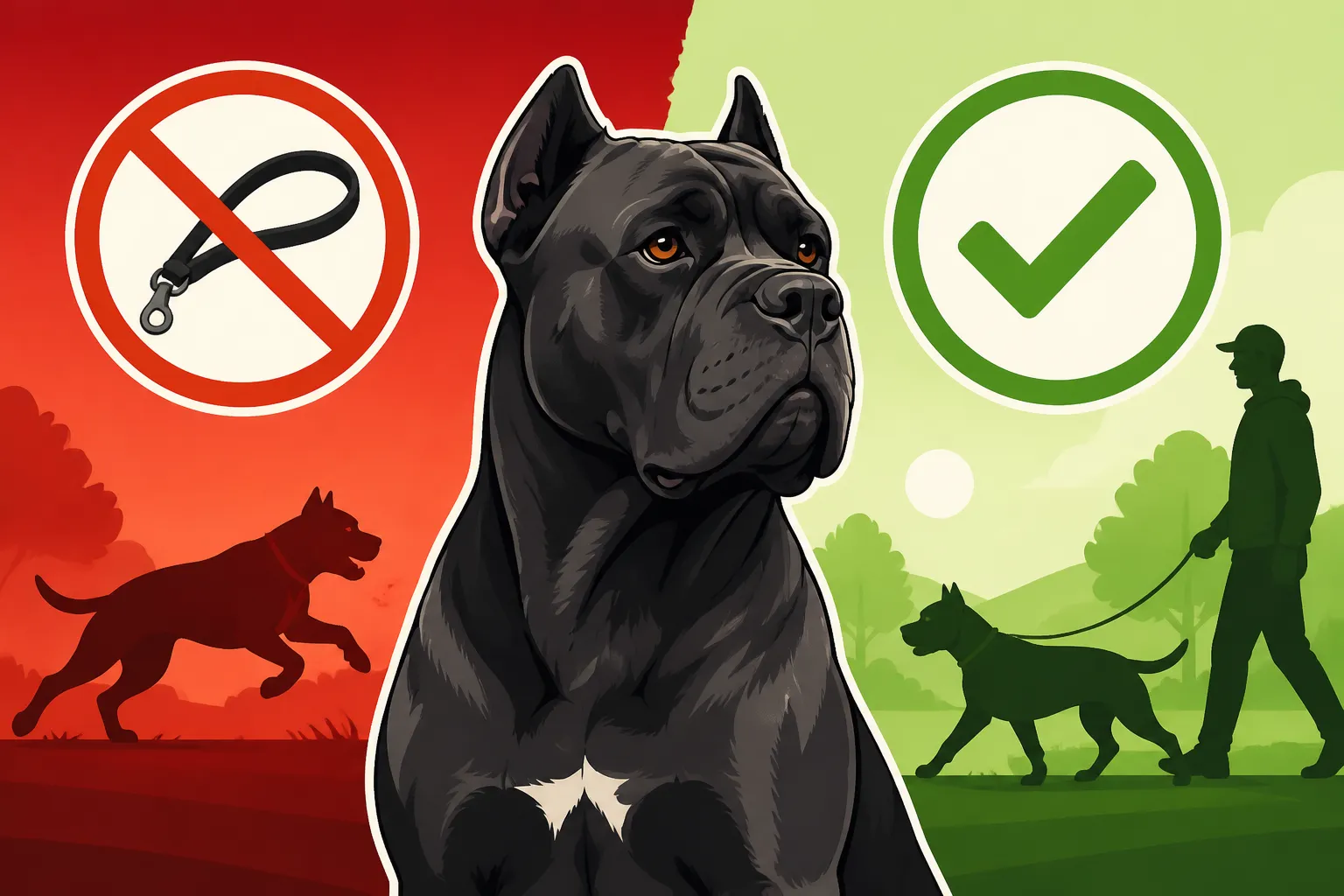
For most Cane Corsos, the reality is that "off-leash" is a spectrum, often leaning more towards "managed freedom" rather than absolute liberty. This approach prioritizes safety and responsibility while still allowing your dog to enjoy certain freedoms.
Long Lines and Tracking Lines: Practical Alternatives
One of the best tools for providing managed freedom is the long line. As mentioned earlier, this is a long, durable lead that can extend anywhere from 15 to 50 feet or more. It allows your Cane Corso to explore, sniff, and move with a sense of independence while you retain control.
When using a long line, your dog learns that they can roam further, but there's always a gentle reminder of your connection. You can use it in parks, open fields, or even your backyard if you want to practice recall with more space. The key is to let the line trail behind them, only stepping on it or picking it up when you need to prevent them from going too far or to reinforce a recall. This is an excellent way to safely practice Using a Long Line With a Cane Corso in varied environments without the full risk of being off-leash. It builds confidence in your dog that they can explore, and confidence in you that you have a safety measure in place. It's especially useful for working through prey drive triggers, allowing you to intercept before a full-blown chase begins.
Secured Fields and Private Parks
Finding truly safe spaces for a Cane Corso to run is often a challenge. Public dog parks come with too many variables. Instead, many owners seek out:
- Private Dog Parks or Ranches: Some areas offer membership-based private dog parks with very secure fencing and rules, often with fewer dogs and more responsible owners.
- Friends' or Family's Fenced Properties: Large, securely fenced yards or acreage can be a godsend. Always double-check the fencing for height, gaps, and dig-under potential.
- Rentable Private Fields: Increasingly, facilities are offering private fields for rent by the hour, providing a completely safe and distraction-free environment for dogs to run.
These types of locations provide the mental and physical stimulation a Cane Corso needs, allowing them to stretch their legs and satisfy their desire to explore, all while minimizing risk.
The "Emergency Recall" is Your Goal
Ultimately, the goal for any Cane Corso owner, whether they ever achieve true off-leash reliability or not, should be a rock-solid emergency recall. This is a distinct command (often a whistle, a unique word, or a series of claps) that means "drop everything and come to me right now."
This emergency recall should be practiced separately from your regular recall and always with the highest value rewards. It's a command you hope you never have to use in a true emergency, but one you need to be absolutely confident in. It's your last line of defense if your dog slips their collar, if a gate is accidentally left open, or if an unforeseen situation arises. For a breed with the potential power and presence of a Cane Corso, this emergency recall is not just a nice-to-have; it's a vital safety measure for their well-being and the peace of mind of everyone around them. This is also why Why Every Cane Corso Should Be Muzzle Trained Early is a smart proactive step, providing an additional layer of safety for unforeseen circumstances.
Conclusion
The allure of an off-leash Cane Corso is powerful, a vision of freedom and perfect obedience. However, the reality of owning such a magnificent, instinct-driven guardian breed necessitates a deeply responsible and realistic approach. While some highly dedicated owners, through years of consistent training and careful management, may achieve situational off-leash reliability in highly controlled environments, it's not a given, nor should it be the default expectation.
Embracing "managed freedom" – through secure fencing, long lines, diligent socialization, and an unwavering commitment to high-value, consistent training – is often the safest and most practical path. It allows your Cane Corso to enjoy mental and physical exercise without putting them, other people, or other animals at undue risk. Remember, the bond you build, the trust you earn, and the safety you provide are far more valuable than the fleeting image of an unrestrained dog. Focus on nurturing their incredible qualities within a framework of responsible ownership, and you'll have a loyal, well-adjusted companion for life.
Disclaimer
This article is for general informational purposes only and does not constitute professional advice. Laws, prices and regulations vary by location and change over time. Consult a qualified professional for guidance on your specific situation.