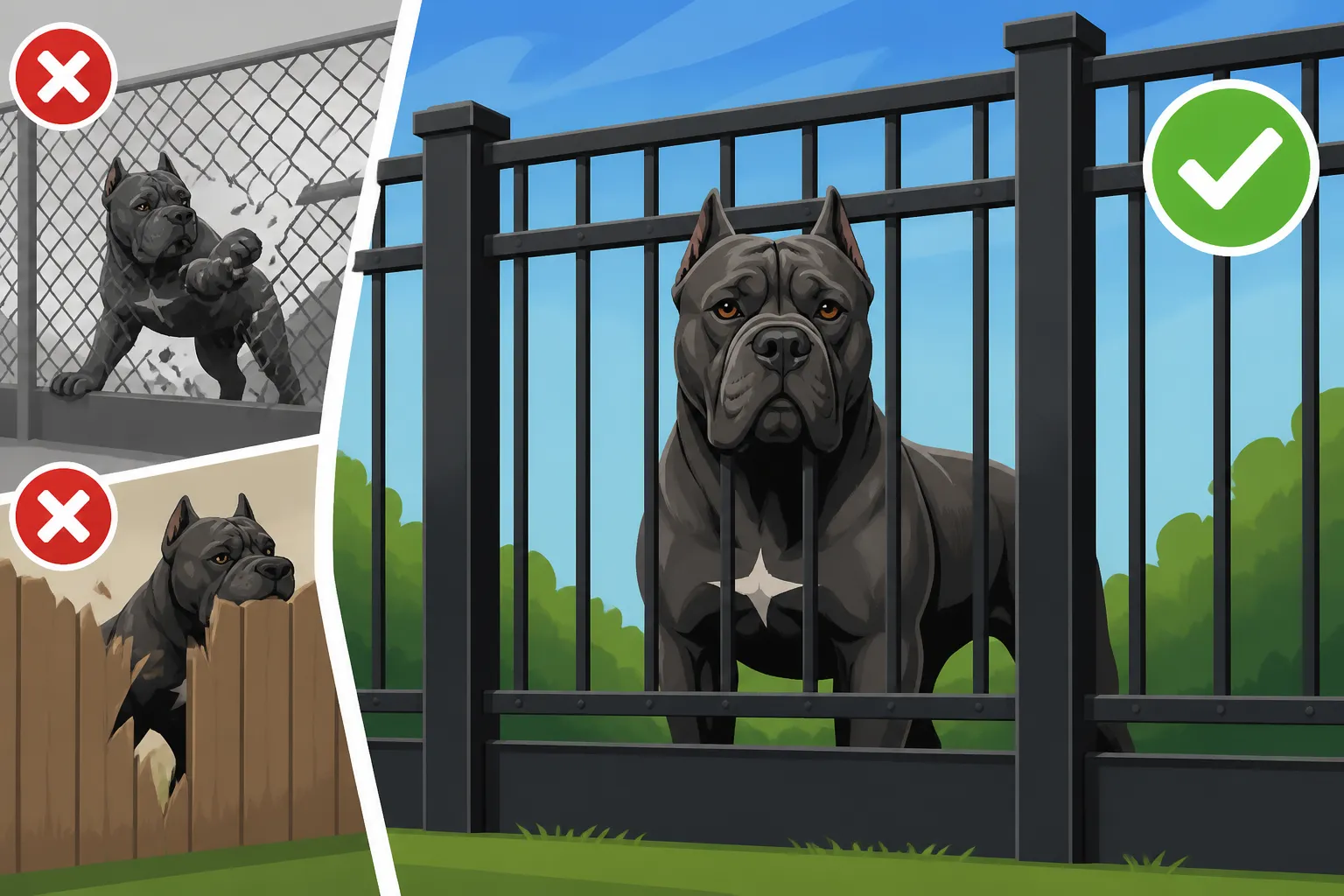
Fencing That Actually Holds a Cane Corso
One of the biggest concerns for any Cane Corso owner, especially if you have an active dog with a strong guarding instinct, is how to keep them safely and securely contained in your yard. It’s a common frustration to see recommendations for fencing that simply won't stand up to the sheer power, intelligence, and determination of this magnificent breed. This guide is here to walk you through exactly what kind of fencing actually works for a Cane Corso, providing real-world insights and practical solutions to give you peace of mind.
Understanding Your Cane Corso's Fencing Needs
When you bring a Cane Corso into your life, you're not just getting a dog; you're welcoming a powerful, intelligent, and instinctively protective animal that requires a containment strategy far beyond what might suffice for a smaller or less driven breed. Their needs aren't just about physical barriers; they're also deeply tied to their historical role and genetic predispositions. Overlooking these unique traits is how many owners inadvertently set themselves up for fence failures and escape attempts.
The Natural Instincts That Challenge Fences
Cane Corsos were bred for centuries to be guardians of property, livestock, and family in rural Italy. This isn't just a learned behavior; it's etched into their DNA. Their protective nature means they are constantly aware of their surroundings, keenly observing anything and anyone that approaches what they perceive as their territory. This inherent vigilance is a double-edged sword when it comes to fencing. While it makes them excellent deterrents, it also means they'll be highly motivated to investigate, challenge, or even attempt to intercept anything they deem a potential threat or anomaly outside their boundaries. A squirrel, a delivery driver, a passing dog, or even a leaf blowing across the yard can trigger their alert system, leading them to test the limits of their enclosure. Understanding this drive is crucial; a fence isn't just keeping them in, it's managing their instinct to go out and perform the job they were bred for.
Strength and Size: Not Your Average Dog
Let's be realistic: a fully grown Cane Corso can easily weigh between 90 and 120 pounds, sometimes more. They are muscular, athletic, and surprisingly agile for their size. This isn't a dog that can be deterred by a flimsy picket fence or a low chain-link barrier. They have the strength to push through weak spots, the mass to lean against and collapse insecure sections, and the power in their legs to jump surprisingly high. Imagine a hundred pounds of determined muscle launching itself at a fence – it needs to be robust. Furthermore, their intelligence often means they'll quickly learn how to exploit any weakness, whether it's an unlatched gate, a loose board, or a spot where the fence meets uneven ground. Ignoring their physical capabilities and mental acuity when planning your fence is a recipe for disaster. We're talking about a dog that could potentially How Much a Grown Male Cane Corso Weighs, and that kind of presence demands a truly secure perimeter.
Traditional Fencing Options and Their Suitability
When considering fencing, many owners first look at traditional materials. While some can be adapted, it’s vital to assess them through the lens of a Cane Corso's specific needs rather than a generic dog. What works for a Labrador might be wholly inadequate for a powerful guardian breed.
Solid Wood Fencing: Privacy and Presence
Solid wood fencing, often six feet or taller, can offer excellent privacy, which some Cane Corso owners appreciate for reducing visual triggers that might prompt barking or fence-fighting with neighbors' dogs. The lack of visibility can certainly help in managing their intense focus on the outside world. A well-built wood fence presents a significant physical barrier, and if constructed properly, it can be quite sturdy.
However, "well-built" is the key phrase here. A Cane Corso can absolutely lean on, jump against, or even chew through weaker wood. Posts need to be deeply set in concrete, and panels secured with heavy-duty hardware. Cedar or redwood are good choices for their durability and resistance to rot, but even then, thickness matters. A common frustration is that standard pre-fab panels often aren't strong enough. You might find your Cane Corso testing the weak spots, pushing at the bottom, or even attempting to dig underneath, especially if they are particularly motivated. This means ensuring the bottom of the fence is either buried slightly or has a sturdy kickboard to prevent digging. While wood fences can look beautiful, they also require regular maintenance, including staining or sealing, to withstand the elements and maintain their integrity against a powerful dog. If your dog is prone to chewing, they might even take a bite out of the fence itself, potentially ingesting splinters.
Chain-Link Fencing: A Budget-Friendly Choice, But Is It Enough?
Chain-link fencing is often a more economical choice and can be quick to install. It provides a clear visual barrier and is generally durable against weather. For some breeds, a standard 4-foot or 6-foot chain-link fence might be perfectly sufficient.
For a Cane Corso, however, standard chain-link often falls short. The main issue is the gauge of the wire and the strength of the posts. A determined Cane Corso can bend, climb, or even break through lighter gauge chain-link. They are notorious for finding the weakest link, literally. We've seen Corsos learn to climb a chain-link fence by using the mesh as a ladder, or push the bottom out to create an escape tunnel. If you opt for chain-link, you'll need at least a 9-gauge wire, ideally 6-gauge, and posts set deep in concrete, spaced no more than 6-8 feet apart. A top rail is absolutely essential to prevent sagging and give the fence more rigidity. Even with these upgrades, the open nature of chain-link means your Cane Corso will have full visibility of everything outside the yard, potentially increasing their guarding impulses and reactivity. This can lead to incessant barking at passersby, which no one wants. For a dog that can quickly develop A Cane Corso That Barks at Everyone Who Passes, a visual barrier might be more beneficial.
Wrought Iron and Ornamental Fencing: Aesthetic Appeal vs. Practicality
Wrought iron or ornamental steel fencing offers a classic, elegant look that can significantly enhance curb appeal. It's incredibly durable against the elements and, if properly constructed, can be very difficult for a Cane Corso to break through. The strength of the metal and the secure post installation make it a formidable physical barrier.
However, this type of fencing often comes with its own set of challenges for Cane Corsos. First, the spacing between the pickets is crucial. If the gaps are too wide, a smaller or younger Cane Corso might be able to squeeze through. Even a larger adult could potentially get their head stuck, leading to injury or panic. Second, just like chain-link, it offers no visual barrier. Your Cane Corso will have an unimpeded view of everything, which can trigger their guarding instincts and lead to excessive barking or fence-line running. While aesthetically pleasing, this might not be the most practical choice for managing a Cane Corso's inherent reactivity. Also, these fences can be very expensive, both to purchase and to install. If you're considering this, ensure the pickets are spaced narrowly enough (typically no more than 3-4 inches apart for a large breed puppy/dog) and that the fence height is substantial, at least 6 feet, to deter jumping.
| Fencing Type | Cane Corso Suitability | Pros | Cons |
|---|---|---|---|
| Solid Wood | Moderate to Good (with upgrades) | Privacy, strong visual barrier, aesthetically pleasing | Requires heavy-duty construction, susceptible to chewing/digging, regular maintenance |
| Chain-Link | Low to Moderate (with heavy upgrades) | More affordable, quick installation, durable against weather | Light gauge is easily bent/climbed, no visual barrier, requires heavy gauge/reinforcement |
| Wrought Iron/Ornamental | Moderate (with narrow spacing) | Highly durable, strong physical barrier, high aesthetic appeal | Expensive, no visual barrier (can increase reactivity), picket spacing critical for safety |
High-Security Fencing Solutions for the Determined Cane Corso
When it comes to securing a Cane Corso, "good enough" often isn't good enough. Many owners find that traditional options, even when upgraded, don't quite meet the mark. This is where more robust, often purpose-built, fencing solutions come into play. These options prioritize security and durability, understanding the powerful nature of the breed.
Welded Wire Fencing: A Sturdier Alternative
Welded wire fencing is a significant step up from traditional chain-link. Instead of interwoven strands, the wires are welded together at each intersection, creating a much more rigid and difficult-to-breach barrier. This design prevents the "ladder effect" that allows some dogs to climb chain-link, and it's far more resistant to bending or pushing.
When considering welded wire for a Cane Corso, look for a heavy gauge, typically 6 or 8 gauge, and a mesh size that prevents climbing or squeezing through. A 2"x4" rectangular mesh is often recommended, as it's too small for a dog to get a foothold for climbing but still allows some visibility. The height should be at least 6 feet, and the posts must be industrial strength, set deeply in concrete. For an extra layer of security, consider burying the bottom edge of the fence or attaching it to a concrete footer to deter digging. Many dedicated Cane Corso owners find this material strikes a good balance between security, visibility, and cost, especially when compared to full masonry. It's a pragmatic choice for those who need a serious perimeter without the prohibitive cost of some other high-security options. You can often find rolls of this at agricultural supply stores or through fencing contractors who understand the needs for large animal containment.
Reinforced Masonry or Block Walls: The Ultimate Deterrent
For ultimate security and peace of mind, a reinforced masonry or concrete block wall is virtually impregnable for a Cane Corso. These structures are built to last, offering an incredibly strong physical barrier that cannot be chewed through, pushed over, or dug under (if built with a proper footer). They also provide a complete visual barrier, which can be invaluable for reducing the external triggers that might cause a Cane Corso to become agitated or reactive.
A solid wall removes the temptation for a Cane Corso to "guard" the fence line against every passing distraction, creating a calmer environment for both dog and owner. This is particularly beneficial for managing A Cane Corso That Barks at Everyone Who Passes. The significant downsides are, of course, the cost and the complexity of installation. Building a proper masonry wall is a major construction project, requiring skilled labor and a substantial investment. However, for those with a high-stakes guarding breed like a Cane Corso, and who prioritize security above all else, it often represents the most reliable solution. Be sure that any gate within the wall is equally robust, made of heavy-duty steel, and secured with multiple robust latches that cannot be easily manipulated or shaken open.
Adding Security Features to Existing Fences
Sometimes, replacing an entire fence isn't feasible, but you still need to bolster security. There are several ways to upgrade an existing fence to make it more Cane Corso-proof.
- Height Extensions: If your current fence is too low (e.g., 4 or 5 feet), you can often add extensions to increase the height to 6 feet or even 8 feet. This could involve adding lattice, additional wood panels, or even specialized dog-proofing systems designed to prevent climbing or jumping.
- Dig Guards/Aprons: For dogs that are enthusiastic diggers, burying a section of wire mesh (such as chicken wire or hardware cloth) horizontally along the base of the fence, extending inwards into the yard by 1-2 feet, can create an effective "apron" that deters digging. Alternatively, a concrete footer can be poured at the base of the fence.
- Coyote Rollers/Roll Bars: These are cylindrical devices installed along the top of a fence. If a dog attempts to jump or climb, the roller spins, preventing them from getting a grip and pulling themselves over. They are an ingenious solution for athletic jumpers.
- Gate Reinforcement: Gates are often the weakest point. Ensure your gate is as tall and strong as the fence itself. Install multiple heavy-duty latches (e.g., a slide bolt at the top and bottom, and a spring-loaded latch) that are challenging for a dog to manipulate. Self-closing and self-latching gate hardware adds an extra layer of protection. Sometimes a simple chain and padlock are the most reliable option for peace of mind. Remember, if you're leaving your Cane Corso alone for extended periods, a gate that can be compromised is a huge liability.
Fencing Types That Just Won't Cut It for a Cane Corso
Just as important as knowing what will work is understanding what definitely won't. Many common fencing types that are fine for other dogs simply pose an unacceptable risk when you own a powerful and intelligent breed like a Cane Corso. Investing in these inadequate solutions is often a waste of money and can lead to dangerous situations.
Invisible Fences: A Mental Barrier, Not a Physical One
Invisible fences, also known as electronic fences or "containment systems," operate by delivering a static correction (a mild shock) when a dog crosses an underground wire. For some dogs and breeds, especially those with lower prey drive and less physical prowess, these systems can be moderately effective as a backup.
For a Cane Corso, however, invisible fences are generally a very poor choice as a primary containment method. Here's why:
- High Drive Overrides Correction: A Cane Corso's strong prey drive or guarding instinct can easily override the discomfort of a static correction. If they see a rabbit, a deer, another dog, or a perceived threat, the urge to pursue or confront is often stronger than the desire to avoid the "zap." They will simply blow through the boundary, and once they're outside, they often won't cross the boundary again to get back in.
- No Barrier for Others: An invisible fence does nothing to prevent other animals or people from entering your yard. This is a critical flaw for a guardian breed. It means your Cane Corso is contained, but external factors that could trigger aggression or pose a threat to your dog can still enter their space.
- Stress and Anxiety: Relying solely on an invisible fence can cause significant stress and anxiety in a sensitive or protective Cane Corso. They are constantly being "punished" for crossing an invisible line, which can lead to confusion, fear, or even fence aggression directed at people or animals inside the boundary. This can have serious implications for their behavior, potentially leading to An Anxious Cane Corso Looks Like.
- Failure Points: These systems are prone to failure, from wire breaks to collar battery issues. Even a momentary lapse can give a determined Cane Corso the opportunity to escape.
In short, for a Cane Corso, an invisible fence is not a physical barrier and therefore not a reliable containment solution. It should never be considered as the sole means of keeping your Cane Corso safely in your yard.
Low-Height Fencing and Decorative Barriers
Any fence under 5-6 feet tall is generally considered inadequate for a Cane Corso. This includes decorative garden fences, picket fences, and most standard backyard fences found in suburban neighborhoods.
- Easy to Jump: A healthy, athletic Cane Corso can easily jump a 4-foot fence, and many can clear 5 feet with minimal effort, especially if motivated. They are powerful jumpers.
- Easy to Push Through: Fences that aren't structurally sound or are made of light materials can be easily pushed over or busted through by a Cane Corso's weight and strength. They have the physical mass to test any weakness.
- No Psychological Deterrent: Low fences offer no psychological deterrent. A Cane Corso will quickly learn they can easily overcome such barriers, making them ineffective.
- Accidental Escape Risk: Even if your Cane Corso isn't actively trying to escape, a low fence creates a serious risk for accidental escapes if they are startled, chasing a squirrel, or get overstimulated.
Investing in a low or decorative fence for a Cane Corso is essentially installing no fence at all in terms of security. It's an illusion of containment that could lead to your dog getting lost, injured, or causing trouble in the neighborhood.
Portable and Temporary Fencing
While portable exercise pens or temporary fencing can be useful for very young puppies under strict supervision, or for short-term situations like camping with your dog, they are absolutely unsuitable for containing an adult Cane Corso.
- Not Robust Enough: Materials like plastic snow fencing, lightweight mesh, or even most portable metal exercise pens are not designed to withstand the strength of a grown Cane Corso. They can be pushed over, collapsed, or even completely torn apart.
- Risk of Entanglement/Injury: A Cane Corso attempting to escape a flimsy temporary fence could easily become entangled, leading to panic, injury, or severe cuts.
- No Security for Others: Like invisible fences, temporary barriers offer no protection from external threats entering your Cane Corso's space.
For any situation where your Cane Corso needs secure outdoor containment, you need a permanent, robust, and well-installed fence. Temporary solutions are just that — temporary, and not designed for the unique demands of this powerful breed. When it comes to something as vital as containment, cutting corners here simply isn't an option.
Installation, Maintenance, and Beyond
Even the best fence material is only as good as its installation and how well it's maintained. For a breed like the Cane Corso, overlooking these crucial aspects can quickly turn a secure perimeter into a liability. It's not just about building it; it's about keeping it escape-proof for years to come.
Professional Installation Versus DIY Challenges
Choosing whether to install your fence yourself or hire professionals is a significant decision. While DIY can save money upfront, it often comes with hidden costs and potential pitfalls, especially when dealing with the requirements for a Cane Corso-proof fence.
- Professional Expertise: A reputable fencing contractor, particularly one with experience in large dog or security fencing, will know the local regulations, soil conditions, and best practices for creating a truly secure barrier. They'll understand the importance of deep post holes, proper concrete mixing, and robust gate hardware. They can also advise on specific materials and designs that are most suitable for preventing escapes and deterring digging, like adding a kickboard or burying the bottom wire of a welded fence. This expertise is invaluable when preventing The Fencing Height a Cane Corso Needs and ensuring stability.
- Specialized Tools and Equipment: Installing a heavy-duty fence often requires specialized tools like post-hole diggers (power augers are a blessing!), concrete mixers, and potentially welding equipment. Renting these tools can add up, and some are difficult for a novice to operate effectively.
- Labor and Time Investment: Building a secure, 200-foot perimeter fence, for example, is a physically demanding and time-consuming project. For someone without experience, it can take weeks of solid effort. Professionals can complete the job much more efficiently, often with a guarantee on their work.
- DIY Risks: Improper installation can lead to a fence that sags, leans, or develops weak points that a Cane Corso will quickly exploit. Imagine spending a weekend installing a fence, only for your dog to find a loose panel within a week. This isn't just frustrating; it's a safety hazard. If you are handy and have some experience, you might tackle a portion, but consider hiring help for the heavy lifting and critical structural components.
Regular Maintenance for Long-Term Security
A fence is not a "set it and forget it" solution, especially with a Cane Corso. Regular inspections and maintenance are absolutely critical to ensure its integrity over time.
- Weekly Perimeter Checks: Make it a habit to walk the entire perimeter of your fence at least once a week. Look for:
- Loose posts: Wiggle them to see if they're stable.
- Damaged panels/boards: Are there cracks, splinters, or missing sections?
- Loose wire/mesh: Are there any gaps or areas where the wire is sagging or broken?
- Digging attempts: Check for fresh holes or areas where your Cane Corso has been trying to burrow under. Fill these immediately and reinforce the spot.
- Gate integrity: Test all latches and hinges. Do they close securely? Is there any sag in the gate itself?
- Overhanging branches: Ensure no tree branches are close enough to the fence to offer a climbing aid or escape route, particularly with a dog that might try to climb as discussed in The Age a Cane Corso Puppy Starts Formal Training.
- Weather Damage: Heavy rains can erode soil around posts, strong winds can loosen panels, and snow/ice can put immense pressure on the structure. After any significant weather event, conduct an immediate and thorough inspection.
- Seasonal Tasks: Depending on the material, you might need to re-stain or seal a wood fence annually, check for rust on metal fences, and clear vegetation that could obscure views or weaken the fence line.
- Address Issues Immediately: Any weakness, no matter how small, is an invitation for a Cane Corso to escape. Don't put off repairs. A small repair today can prevent a major headache (or heartache) tomorrow.
Beyond the Fence: Training and Supervision
No fence, however robust, is a substitute for responsible ownership, proper training, and diligent supervision. Think of your fence as the last line of defense, not the only one.
- Training for Boundaries: Even within a secure fenced yard, it’s beneficial to teach your Cane Corso "yard boundaries." Use positive reinforcement to teach them not to rush the fence line, bark excessively at passersby, or dig. Commands like "leave it" or "come" can be crucial if they become overly focused on something outside the fence.
- Mental and Physical Exercise: A bored or under-exercised Cane Corso is a Cane Corso looking for trouble, and that often means looking for a way out. Ensure your dog gets plenty of mental stimulation through training, puzzle toys, and scent work, and adequate physical exercise tailored to their age and joint health. This helps manage their energy and reduces the motivation to escape. A dog that is physically and mentally satisfied is far less likely to challenge their containment. Neglecting this can lead to The Damage a Bored Cane Corso Does Indoors.
- Supervised Yard Time: Never leave your Cane Corso unsupervised in the yard for extended periods, even with the most secure fence. Things can happen quickly – a gate might accidentally be left ajar by a visitor, a sudden strong motivation might appear outside the fence, or an unknown threat could enter the property. Supervision allows you to intervene, reinforce good behavior, and address potential escape attempts before they become successful.
- Emergency Preparedness: Have a plan for if your Cane Corso does get out. Ensure they are microchipped, have up-to-date ID tags on their collar, and are registered with local animal services. Know your dog's favorite routes or hangouts if they do escape, and practice a strong recall regularly, even if you never intend to let them off-leash.
Your Cane Corso's safety and the peace of mind of your community depend on a multi-faceted approach to containment, where a secure fence is a cornerstone, but not the entirety, of your strategy.
Disclaimer
This article is for general informational purposes only and does not constitute professional advice. Laws, prices and regulations vary by location and change over time. Consult a qualified professional for guidance on your specific situation.