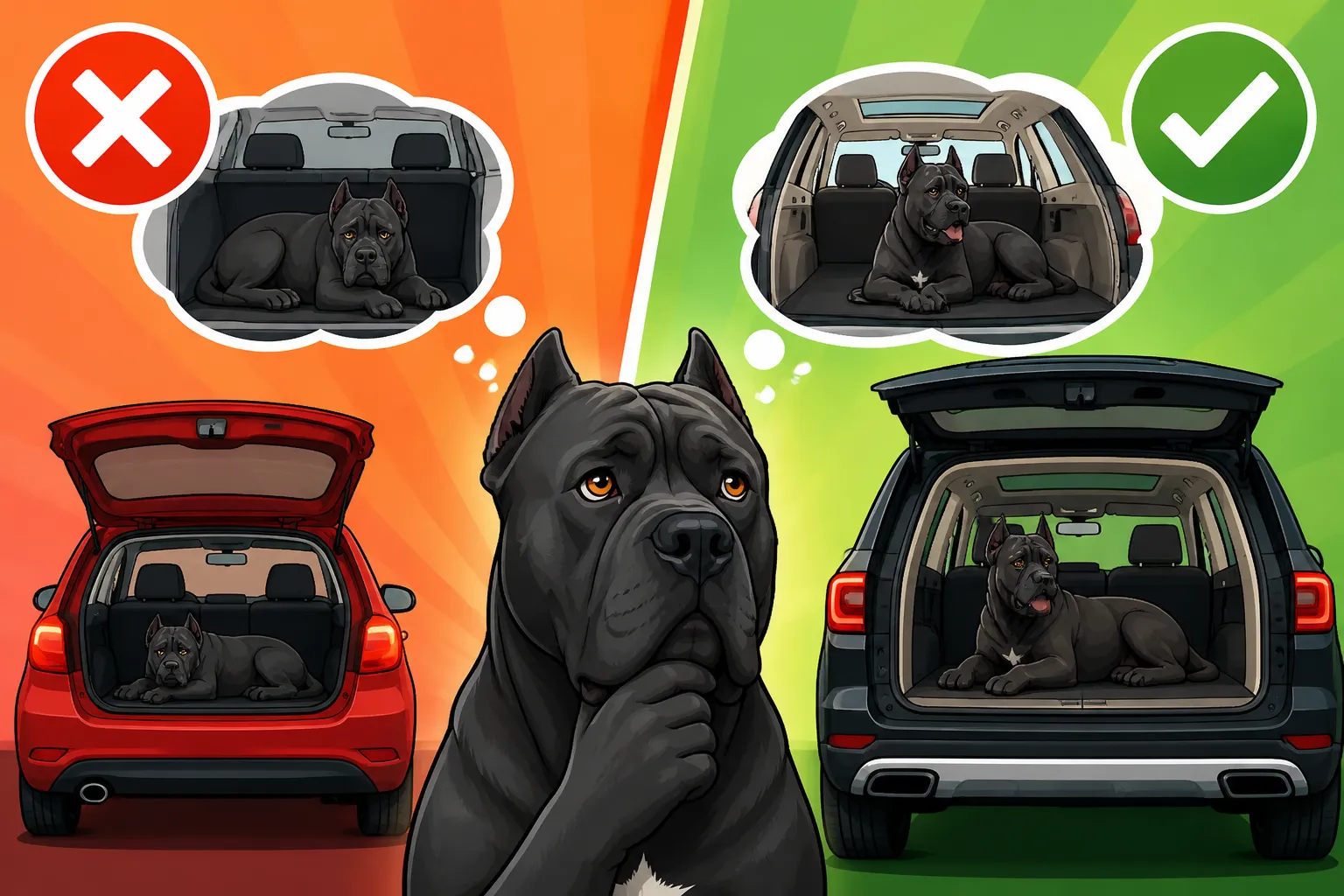
Whether a Cane Corso Owner Needs a Bigger Vehicle
A Cane Corso can turn an ordinary car ride into a space-and-safety puzzle: the dog may fit through the door, but still have nowhere secure to stand, lie down, or ride comfortably. A bigger vehicle can help, but it is not automatically necessary. This guide explains how to assess your current car, compare practical vehicle layouts, and plan safer trips with a large dog.
Does a Cane Corso actually need a bigger vehicle
Not necessarily. The answer depends less on the breed label than on your individual dog, the vehicle’s layout, and what you need to bring along. A young Cane Corso riding alone on a short trip has different needs from a mature dog sharing the back with another dog, a child’s car seat, and weekend luggage.
The useful question is not simply, “Can my dog fit?” It is, “Can my dog travel securely and comfortably, with enough space for the restraint or crate we plan to use?”
Start with your dog’s real measurements
Measure your dog while standing and lying down, rather than relying only on an estimated adult weight. Note the height from the floor to the top of the head, the length from nose to the base of the tail, and the width when your dog is lying naturally. A dog that can squeeze into a small space may still be unable to settle comfortably there for a longer drive.
Then measure the vehicle’s usable area. Check the opening where your dog would enter, the width between wheel wells, the height under any cargo cover, and the length available with the seats in their usual position. A sloping rear hatch can make the interior feel roomy at floor level while leaving little headroom where the dog would actually sit or lie.
Try the setup before relying on it for a trip. Park somewhere safe, open the doors or hatch, and see whether your dog can get in, turn around, lie down, and get out without being wedged against trim or a seat. If you’re considering a crate, measure the crate itself, not just your dog. The crate needs to fit through the opening and sit securely inside.
This kind of check is especially helpful if you’re still deciding whether the breed fits your daily life. What First Time Cane Corso Owners Say They Underestimated explores the practical realities that can be easy to miss before bringing one home.
Think about your everyday trips
A vehicle that works for a quick visit to a nearby veterinarian may not work for a long highway drive. Consider the trips you actually take: routine appointments, training classes, hikes, family visits, or travel that involves luggage. Think about who else rides in the car, too. A large dog may occupy most of the rear area even when there’s technically room for another passenger.
The dog’s age and mobility matter. A young adult who jumps into a car easily may find a high cargo floor harder to manage as they age, recover from an injury, or develop joint stiffness. If your dog is reluctant to load up or needs help getting down, a ramp may make a vehicle more workable. See Whether a Cane Corso Needs a Ramp for the Truck for more on that specific consideration.
If the problem is not day-to-day space but arranging occasional trips, you may not need to replace your car. Borrowing a suitable vehicle for a long journey, choosing a dog-friendly destination closer to home, or making a separate trip for bulky luggage can be simpler than buying a larger vehicle. For broader planning, Travel Costs With a Hundred Pound Cane Corso covers the extra logistics that can come with traveling alongside a large dog.
Which vehicle layouts tend to work best
A vehicle’s shape often matters more than its advertised cargo capacity. A wide, flat, easy-to-access space can be more useful than a larger-looking area with a high step, a steeply sloped hatch, or awkwardly placed seatbacks.
| Vehicle layout | Potential advantages | Things to check |
|---|---|---|
| Sedan | May be enough for a dog using a suitable rear-seat restraint | Limited cabin height and cargo access; a crate may not fit |
| Hatchback or wagon | Often offers a lower, more open cargo area | Rear seats, hatch slope, and cargo-floor length can limit usable space |
| Compact SUV | Higher seating and a flexible cabin layout | The cargo floor may be high, and the wheel wells may narrow the space |
| Larger SUV | Can provide more room for a crate, passengers, or travel gear | A tall entry can be difficult for a dog to climb into |
| Minivan | Often has a broad, adaptable interior and convenient access | Seat removal or folding arrangements must leave a secure place for the dog |
| Pickup truck | Can carry equipment and may accept a crate in the cab | An unsecured dog should not ride in an open truck bed; cab space may be limited |
Sedans, hatchbacks, and wagons
A sedan can work if your dog can ride in the rear seat with a properly fitted, suitable restraint and the seat area accommodates the dog without interfering with passengers. The trunk is not a safe substitute for a passenger area: it may not provide appropriate ventilation, visibility, or a secure way to restrain the dog.
Hatchbacks and wagons often provide a more practical cargo opening than sedans. The rear seats may fold to create a longer flat space, though you’ll want to check whether the resulting surface is level and whether the dog can be secured there. A steeply angled rear window can also limit the size of a crate, even if the floor area looks generous.
A smaller vehicle may still work if the dog is the only passenger in the back and you have a restraint system that suits the car and the dog. But if a crate is important to your plan, confirm that a correctly sized crate fits through the hatch and can be anchored. A crate that fits only when the seats are folded may rule out carrying rear-seat passengers on the same trip.
SUVs, minivans, and pickups
SUVs appeal to many large-dog owners because of their open cargo areas, but “SUV” covers a wide range of layouts. Some have a high lift-over point that makes loading difficult; others have a narrow cargo floor or a substantial slope behind the rear seats. Measure the opening and the floor, and consider how your dog will get in and out—not just how much cargo volume the vehicle claims.
Minivans can be useful when you need room for both people and a dog. Sliding doors may make loading easier in a crowded parking spot, and the cabin can offer several ways to arrange passengers. Still, make sure the dog’s spot is separated from loose luggage and that the restraint or crate can be installed as intended. Folding or removing seats should not leave unsecured gaps or surfaces where the dog could slide.
A pickup’s enclosed cab may work if there is a secure, suitable place for the dog inside it. An open truck bed is not a safe place for an unrestrained dog, even for a short drive. If you use a truck and your dog needs to load into a high cab or access a crate, a ramp may also be worth considering. Compare specific models in person when possible: seat shapes, doors, and cargo-floor height vary enough that the name of the vehicle class won’t answer the question.
Plan for safe restraint, not just more room
Extra room does not protect a dog during sudden braking or a collision. A loose dog can be thrown forward, distract the driver, or be injured by unsecured objects. A large, heavy dog can also make it difficult for a person to manage an emergency exit. Whatever vehicle you choose, plan how your Cane Corso will be restrained before you set off.
Choose a restraint that fits the vehicle
Some owners use a crash-tested harness attached according to the manufacturer’s instructions; others use a secured crate that fits the dog and the vehicle. These options are not interchangeable in every car, so check the product instructions and the vehicle’s owner information. A harness should fit the dog correctly and connect to an appropriate anchor point. A crate should be sized for the dog and secured so it cannot slide or tip.
Avoid assuming that a barrier alone is equivalent to a restraint. A barrier can help keep a dog out of the front seats, but it may not prevent the dog from being thrown around during a crash. Likewise, a leash clipped to a collar is not a substitute for a travel restraint and can create a dangerous situation if the dog is jolted.
If you’re comparing crate and barrier options, Vehicle Crates and Barriers for a Cane Corso is a useful next read. For the everyday equipment that needs to fit a large dog, see Crates, Collars and Leads Sized for a Cane Corso. When shopping for travel basics such as a spill-resistant water bowl or cleanup supplies, Chewy may be one place to compare options; check that any item you choose works with your actual setup.
Keep the cabin clear and comfortable
The dog should have a stable area and enough room to change position without climbing onto a passenger or becoming trapped by bags. Secure suitcases, folding chairs, and other gear separately. Even a soft duffel can become a hazard if it slides during a sudden stop.
Make the travel area comfortable without creating a pile of loose bedding that interferes with restraint. A nonslip mat can help some dogs feel steadier, while a familiar blanket may make the space less strange. Test any bedding with the restraint installed; the dog should not be able to slip underneath a harness or push the crate door open.
Bring water and plan for safe breaks, particularly on longer drives. A collapsible bowl can be easier to store than a bulky one; Chewy is another retailer where owners may compare travel bowls and other dog supplies. Keep treats and waste bags accessible to the person who is not driving, and never reach back to hand something to the dog while the vehicle is moving.
Be thoughtful about loading and unloading
A tall vehicle can be convenient for people and difficult for dogs. Repeatedly jumping in and out may be uncomfortable, especially for puppies whose bodies are still developing or older dogs with mobility changes. Teach your dog a calm loading routine, and use a sturdy ramp or assistance if jumping is not appropriate for that dog.
Practice in a quiet place before you need to make a rushed appointment. Reward your dog for approaching the vehicle, waiting while the door opens, and entering only when invited. If your dog panics, plants their feet, or tries to scramble out, pause and work gradually rather than forcing them into the car. A towel, spare lead, and cleanup supplies can be useful in the vehicle; Chewy may help you compare some of those everyday items, but the priority is choosing gear that can be stored securely.
For some dogs, discomfort during loading is a sign to ask a veterinarian about mobility rather than simply buying a taller or roomier vehicle. If the vehicle is a pickup or has a high cargo floor, test the ramp’s stability and angle with your dog’s comfort in mind before using it on a busy roadside.
How to decide whether to upgrade
A vehicle change may be worthwhile when your current car cannot accommodate a safe restraint, the dog cannot enter and exit without strain, or there is no workable arrangement for the people and equipment you regularly carry. But if the only issue is occasional luggage or a single long trip, a change in packing habits or travel plans may solve the problem without replacing the car.
Use a practical fit test
Before deciding, write down the details of a typical trip. Include the dog, the people who ride along, the restraint or crate, and the items you need to carry. Then test the current vehicle with that exact combination. A vehicle that looks spacious when empty may feel very different with a crate, stroller, groceries, or a second passenger in place.
Check these questions:
- Can your dog enter and exit without struggling or jumping in a way that concerns you?
- Can your dog sit or lie down comfortably while properly restrained?
- Can the restraint or crate be secured according to its instructions?
- Can passengers sit safely without crowding the dog or compromising the restraint?
- Can bags and equipment be secured separately from the dog?
- Does the arrangement still work for the trips you make most often?
If the answer to several questions is no, compare vehicles by measuring actual interiors rather than choosing by badge, body style, or advertised cargo volume. Bring the crate or measurements when visiting a dealer, and check how the rear seats fold, whether the floor stays level, and how high the dog must climb.
Consider ownership beyond the cargo area
A larger vehicle may solve the loading and space problem, but it can bring other trade-offs: parking, fuel use, storage at home, and the ease of driving in your usual neighborhood. If your daily routine involves narrow city streets or a tight parking garage, a roomy model that is frustrating to drive may not feel like an improvement.
Also consider where the dog will stay when the car is parked. A vehicle is not a place to leave a dog unattended in unsafe heat or cold. Shade, open windows, or a water bowl do not make a parked vehicle safe in extreme conditions. Plan trips so your Cane Corso can remain with a person or in an appropriate environment.
A large dog can influence more than the vehicle decision. Apartment rules, local restrictions, and the shape of your household all affect how practical ownership feels. Whether a Cane Corso Works in a City Apartment and Whether a Cane Corso Can Be Left During a Work Day may help you think through those wider logistics.
Make the decision around your particular dog
There is no single vehicle every Cane Corso owner needs. One dog may ride securely in a roomy rear seat, while another needs a crate that only fits in a larger vehicle. A dog’s body size, confidence, mobility, travel habits, and the people sharing the car all change the answer.
Make the decision after measuring and testing, not from the assumption that a big breed automatically requires a big SUV. If your current car can hold a suitable restraint, provide a comfortable travel space, and accommodate your usual passengers and gear, you may not need to upgrade. If it cannot, a different layout—not necessarily the largest vehicle available—may make every trip calmer and safer.
Disclaimer
This article is for general informational purposes only and does not constitute professional advice. Laws, prices and regulations vary by location and change over time. Consult a qualified professional for guidance on your specific situation.