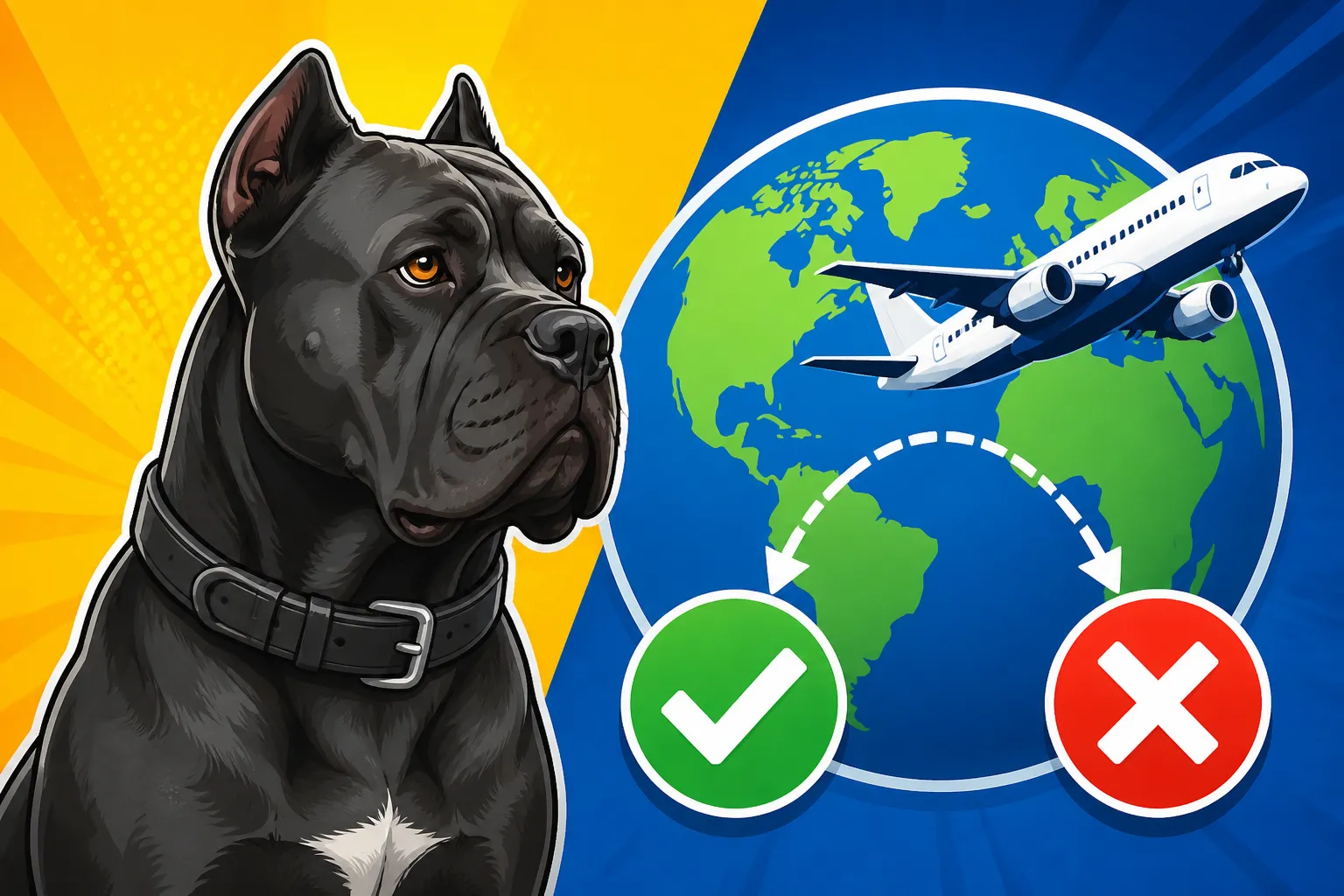
Whether a Cane Corso Can Fly Into Every Country
A Cane Corso cannot simply board a flight to any destination: a country may restrict the breed, require extensive health paperwork, or allow entry while an airline refuses to carry the dog. That uncertainty is stressful when you’re trying to plan a move or a long trip. This guide explains how to check the destination, choose a travel route, and prepare your dog safely.
Why a Cane Corso May Not Be Able to Fly Everywhere
Country entry rules and breed restrictions are separate checks
A country’s permission to import a dog does not guarantee that every breed can enter. Some places have laws that restrict particular breeds or dogs considered dangerous, while others set rules around ownership, registration, or how a dog must be handled in public. The details can differ between a country, a state or province, and a local municipality.
That means “Can dogs enter this country?” is only the first question. You also need to ask whether Cane Corsos are specifically restricted, whether the breed’s name is treated differently from similar breeds, and whether local rules apply once you arrive. A rule that affects ownership may matter even if the dog is permitted to travel through an airport.
Do not rely on a social media post, an old travel forum, or a general airline page to settle the question. Start with the destination’s official animal import authority and the local government where you’ll stay. For travel within the United States, check state and local rules as well; Whether a Cane Corso Is Banned in Any US State and Whether Cane Corsos Are Named in Breed Specific Legislation offer useful context on why rules can vary.
Airline acceptance is another hurdle
Even when the destination allows Cane Corsos, the airline may have its own restrictions. Large dogs generally cannot travel in the passenger cabin unless they meet the carrier’s specific rules for an assistance animal. A Cane Corso will usually be too large for an under-seat carrier, so the practical options may involve checked pet travel, cargo transport, or a different form of transport.
Airline policies can consider the dog’s size, weight, crate dimensions, breed, route, aircraft type, and weather. Some carriers limit which routes accept animals or pause pet transport in very hot or cold conditions. A dog’s short muzzle may also affect eligibility, because some airlines place additional limits on transporting breeds they consider at risk of breathing problems. Ask the airline about its policy for a Cane Corso specifically, rather than assuming that a general “large dog” policy covers your case.
An accepted reservation is not the same as a guaranteed flight plan. Aircraft changes, connections, seasonal rules, and staffing can affect whether an animal can travel on a particular itinerary. Get the policy in writing where possible, and confirm every flight segment, including any connecting carrier.
A quick way to separate the checks
| Check | What to confirm | Why it matters |
|---|---|---|
| Destination rules | Breed eligibility, import permit, ownership rules, and local restrictions | A country may allow dog imports but restrict particular breeds |
| Health requirements | Microchip, vaccinations, tests, certificates, and deadlines | Missing one step can delay or prevent travel |
| Airline rules | Breed policy, crate standards, route acceptance, and weather limits | Airline approval is separate from government permission |
| Transit rules | Requirements for each layover country and airport | A connection can trigger extra rules even if the destination is straightforward |
| Arrival arrangements | Inspection, approved entry point, and onward transport | You need a workable plan after landing, not just a flight booking |
How to Check the Destination Before Booking
Start with official import requirements
Once you know the destination, look for its official government guidance on bringing dogs across the border. Requirements commonly include a microchip, proof of rabies vaccination, a veterinary health certificate, and sometimes additional treatments, tests, permits, or waiting periods. The combination depends on the destination and where the dog is travelling from.
Pay close attention to the order of steps. A microchip may need to be implanted before a vaccination counts for travel purposes. A certificate may need to be issued within a defined period before departure, and some destinations require a specific government endorsement. These are details that are easy to miss when you are focused on booking flights.
Ask your veterinarian to help interpret the health steps, and contact the relevant government authority if anything is unclear. Keep a written checklist with each requirement, who is responsible for it, and the date it must be completed. Requirements can change, so check them again as your travel date approaches rather than treating an old checklist as permanent.
Check the whole route, not only the final country
A layover can complicate an otherwise workable trip. Depending on the route, you may need to meet transit requirements, collect your dog and check in again, or use an airport that can handle animal transfers. If you are changing airlines, the second carrier may have a different pet policy from the first.
When possible, look for a route with fewer connections and enough time to handle disruptions. A tight connection is especially stressful if your dog is travelling separately from you or must be transferred between carriers. Ask who is responsible for the dog during the connection and what happens if the first flight is delayed.
A move also involves more than the border crossing. If your destination has breed-specific rules, confirm the requirements at your actual address, not just the national entry rules. If the move is within the United States, local licensing and ownership rules may also matter; Whether a Cane Corso Needs a Special Dog License is a helpful related topic to review.
Ask the airline direct, detailed questions
Contact the airline’s animal-travel team before paying for a ticket you cannot use. Give them your Cane Corso’s approximate adult size, route, dates, and crate dimensions, and ask whether that exact breed and itinerary are accepted. If your dog is still growing, ask how the airline assesses size and whether the crate must accommodate the dog’s expected dimensions at the time of travel.
Request the rules for crate construction, ventilation, closures, absorbent bedding, water access, food instructions, and identification labels. Ask whether your dog will travel as checked baggage or through cargo, and where you must drop off and collect the animal. Also ask whether there are weather-related restrictions or limits for short-muzzled breeds.
Keep a record of the answers and the name or department you spoke with. If a policy is unclear, get clarification before booking. This is not the moment to discover at the airport that a crate is too large for the aircraft or that the route does not accept dogs in that travel category.
Preparing a Cane Corso for Air Travel
Choose a crate that fits the dog and the airline’s rules
A travel crate has to be large enough for your dog to stand, turn around, and lie down naturally, while also meeting the airline’s specifications. Cane Corsos are powerful, heavy dogs, so a crate that is technically the right length but has weak latches or flexible panels is not a safe solution.
Measure your dog and compare the dimensions with the carrier’s requirements. Do not buy a crate based only on a breed-size chart; individual dogs vary, and airlines may calculate acceptable dimensions in a particular way. Check the door, bolts, ventilation, handles, and water attachment before travel. If you are shopping for supplies, Chewy may be useful for comparing basic travel items such as bowls, bedding, and crate accessories, but verify the airline’s crate standards before ordering.
Crate practice should start well before departure. Leave the crate open at home, add familiar bedding if permitted, and feed meals or offer calm rewards near it. Gradually encourage your dog to spend relaxed periods inside with the door closed. A dog who has never been confined in a crate should not be expected to adapt calmly during a noisy airport journey.
Make a realistic health and comfort plan
Air travel can be physically demanding, particularly for a large dog. Before booking, speak with your veterinarian about your Cane Corso’s health, breathing, stress, and suitability for the planned route. This is especially important if your dog has a history of respiratory issues, heart problems, anxiety, or mobility limitations.
Do not sedate your dog for a flight unless a veterinarian has specifically advised you and the airline permits it. Sedation can affect a dog’s ability to respond to stress and changes in the travel environment. Your veterinarian can discuss safer approaches to preparation and whether a particular dog should travel by air at all.
Pack familiar essentials for the journey and arrival. A leash, identification, a small supply of the dog’s usual food, waste bags, and any prescribed medication belong on your planning list. Chewy can be one option for finding practical items such as a spill-resistant travel bowl or familiar food, but bring enough supplies to cover delays and check the carrier’s rules about what can accompany the dog.
Prepare for airport handling and arrival
Before travel day, help your Cane Corso become comfortable with being handled by someone other than you. Practise calm leash handling, brief separations, and entering and exiting the crate. Make sure your dog’s identification details are current and that you have copies of relevant health and travel documents stored separately from the originals.
On departure day, follow the airline’s instructions about feeding and water. Avoid making last-minute changes to food or introducing new treats that could upset your dog’s stomach. Give your dog a chance to toilet before check-in, and allow extra time for paperwork and crate inspection.
Plan the first hours after landing, too. Know where you will collect your dog, how you will get to your accommodation, and where your dog can drink, rest, and toilet. A long flight followed by a hot walk through an unfamiliar city is a rough start for any dog. If you need travel basics for the arrival kit, Chewy may help you source familiar food or routine supplies ahead of time, but check import rules before packing food across a border.
When Flying Is Not the Best Option
Consider the dog’s comfort, not only whether travel is allowed
Legal permission and airline acceptance answer whether a dog can travel; they do not answer whether flying is the right choice for that individual dog. A healthy, crate-trained adult may cope differently from a young puppy, a senior dog, or a Cane Corso with breathing difficulties or severe travel anxiety.
Think through the full journey: getting to the airport, check-in, waiting, flight time, connections, possible delays, border inspection, and transport to your destination. A route with multiple transfers may be more demanding than a direct flight, even if both are technically permitted. Your veterinarian can help you weigh the dog’s health and stress risks against the alternatives.
For a temporary trip, a trusted sitter or boarding arrangement may be kinder than bringing your dog. For a permanent move, driving or using a specialist animal transport service may be worth exploring, depending on the distance, route, and your dog’s needs. The right choice is the one that is lawful and workable while also taking your Cane Corso’s welfare seriously.
Compare your options before committing
| Option | Potential advantage | Main concern |
|---|---|---|
| Cabin travel | Dog remains near the owner | Usually not practical for a Cane Corso because of size and carrier limits |
| Airline cargo or checked pet travel | Can make long-distance travel possible | Airline, route, crate, weather, and health restrictions may apply |
| Driving | More control over stops and routine | Long journeys require careful planning, safe restraint, and suitable rest stops |
| Specialist pet transport | Experienced help with complex logistics | Services and routes vary; check credentials, procedures, and communication |
| Temporary care at home | Avoids the stress of travel for a short trip | Requires a dependable caregiver and clear care instructions |
If you are moving, consider the rest of your transport setup as well. A large dog needs enough room to travel safely and settle comfortably at the destination; Whether a Cane Corso Owner Needs a Bigger Vehicle explores some of the practical space concerns owners face. For a temporary absence, Traveling Often With a Cane Corso Left at Home can help you think through care arrangements.
Build a go or no-go checklist
Before you buy tickets, confirm that the destination permits your dog, the airline accepts the breed on every flight segment, and you can meet all health and crate requirements on time. Also make sure the route has a realistic plan for delays and that the dog’s health and temperament are suitable for the journey.
If one part remains uncertain, pause and resolve it before making non-refundable arrangements. Call the destination authority, airline, veterinarian, or a qualified animal-transport professional as appropriate. A little extra planning is frustrating, especially when you already have a move or holiday to organize, but it is far easier than discovering a problem at the airport.
Flying with a Cane Corso can be possible on some routes, but permission is never universal. The destination’s rules, airline policies, route details, and your individual dog all matter. Check each layer independently, confirm the details close to travel, and be willing to choose another plan if the journey is not safe or workable.
Disclaimer
This article is for general informational purposes only and does not constitute professional advice. Laws, prices and regulations vary by location and change over time. Consult a qualified professional for guidance on your specific situation.